






 Portuguese
  Spanish


The idea is to replace the boom that shatters windows with a muffled sound, similar to a car door slamming in the distance. For this, the plane has an extravagant shape and the pilot doesn’t even see ahead: uses cameras and screens. The long-awaited first supersonic flight is about to happen.
Flying faster than sound without the boom that frightens entire cities is the mission of NASA’s X-59. The experimental aircraft was designed to transform the traditional and noisy sonic boom into a much softer sound, and its first flight, recalled by test pilot David “Nils” Larson, paved the way for supersonic tests that could help overturn a ban that has existed in the United States since the 1970s.
The X-59 is developed by NASA in partnership with manufacturer Lockheed Martin and made its first flight, still at subsonic speed, on October 28, 2025, taking off from Palmdale towards the agency’s flight research center in Edwards, California. It’s worth situating the reader in time: since then, the aircraft has undergone a series of test flights, and NASA is aiming precisely for early June 2026 for its first flight above the speed of sound, a long-awaited milestone that, at the time of this publication, is considered imminent.
The mission to silence the sonic boom
When an aircraft exceeds the speed of sound, it generates the so-called sonic boom, a loud and sudden noise caused by shock waves, capable of scaring people and even causing damage, and it was precisely for this reason that commercial supersonic flights over populated areas were banned in the United States in 1973.
-
Qatar Commissions World’s Largest Gas Ship, a 344-Meter Giant Now Under Construction

-
Expert Challenges Alarmism Over El Niño in Brazil: Atmosphere Yet to Respond to Warm Pacific, Advises Farmers Against Selling Cattle or Delaying Planting Before September
-
In a Degraded Atlantic Forest Area, a São Gonçalo Resident Transforms Land into a Living Eco-Museum, Now a Model for Environmental Education

-
World’s First Lithium-Sulfur Battery Factory Launches, Promising to Double Range Without Relying on China


The proposal of the X-59, the centerpiece of the mission named Quesst by NASA, is to demonstrate that it is possible to fly faster than sound producing only a muffled sound, compared by the agency to a car door slamming in the distance.
If the technology works as expected, it could change decades of aviation rules, paving the way for a new era of faster air travel, although this is a medium-term goal, dependent on testing.
An Unusually Shaped Airplane
Just look at the X-59 to realize that it is not just any aircraft.
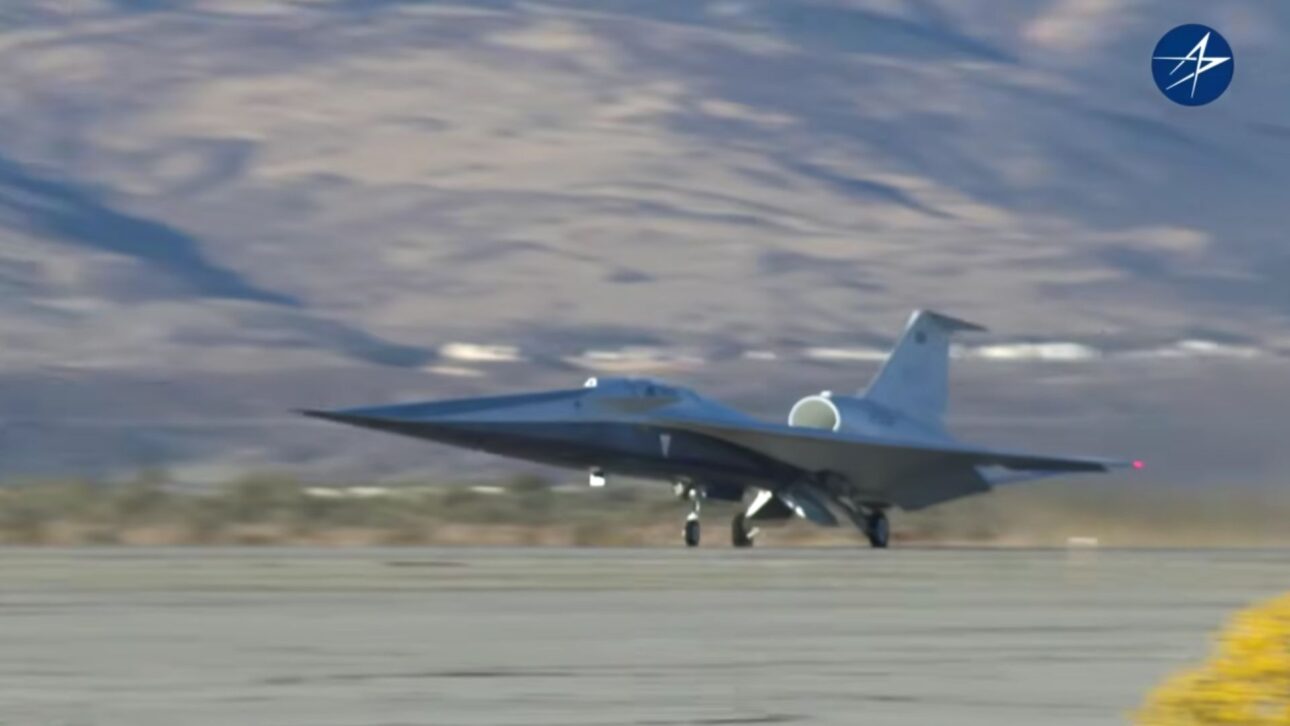
Its nose is extremely long and thin, projecting well ahead of the cockpit, and the fuselage is elongated and narrow, a design intended to disperse shock waves and prevent them from merging into the typical sharp boom of supersonic planes, transforming this noise into the soft thump the mission aims to achieve.
This shape is so radical that the pilot cannot even see forward in the traditional way, as there is no conventional front windshield.
Instead, the X-59 uses an external vision system, with cameras transmitting the image from the front of the plane to screens inside the cockpit.
It is an innovative engineering solution, created to enable precisely the elongated nose that is essential for controlling the sound generated at high speed.
The Pilot’s Account of the First Flight
The historic moment was experienced by NASA test pilot Nils Larson.
According to his account, he didn’t lose sleep the night before, confident in the quality of the plane and the team, and described the first flight as very stable, commenting that the aircraft behaved very similarly to the simulator, exactly what is desired in a debut, without major scares or unforeseen events.
Larson said he was impressed with the performance, even thinking he was piloting a rocket due to the acceleration, but noted that an exciting first flight and at the same time without major events is precisely the ideal result.
This inaugural flight marked the beginning of the so-called envelope expansion phase, where engineers gradually test how the plane behaves at different speeds and altitudes, paving the way for supersonic flights.
What Comes Next and the Race Against an Old Ban


The first flight was just the beginning of a long journey of testing.
After validating performance and safety, NASA intends to confirm the most important part: measuring the sound that actually reaches the ground by flying over selected communities in the United States and asking residents how they perceive the noise, in a data set that will be delivered to regulators in the country and abroad.
This is where the regulatory issue comes in.
This data can serve as a basis for authorities like the United States aviation agency to establish new noise limits and, eventually, reverse the ban on supersonic flights over land.
In fact, in March 2026, the United States House of Representatives approved a bill that pressures the regulatory agency to review the 1973 rule, provided no boom reaches the ground, indicating that the topic is also advancing in the political field.
Why this might interest Brazil and the world
More than a technological curiosity, the X-59 could have a global impact.
If silent supersonic flights become viable and allowed, this could drastically shorten long-distance air travel times worldwide, benefiting passengers and potentially opening a new market for the aeronautical industry, of which Brazil is a significant part through Embraer.
Although the X-59 is a research aircraft, not a future commercial plane, the data it generates could influence the development of new jets by manufacturers worldwide.
For a country like Brazil, with a strong aviation tradition, keeping up with this type of advancement is strategic, as it helps to understand where air transport is heading in the coming decades and what opportunities might arise in this new scenario.
NASA’s X-59 represents one of the boldest attempts to reinvent supersonic flight, aiming to prove that it is possible to break the sound barrier without disturbing those on the ground.
With its revolutionary design and the success of its first flight, recalled by pilot Nils Larson, the project is approaching the decisive moment: tests above the speed of sound.
If all goes well, this experimental aircraft could help overturn a ban of more than fifty years and redesign the future of air travel, in an achievement that the whole world will closely follow.
And you, would you like to see the return of supersonic flights, faster and without the boom that bothered cities? Do you believe the X-59 will be able to fulfill this promise? Leave your comment, share what you think about this technology, and share the article with those interested in aviation, science, and innovation.


