Portuguese
  Spanish


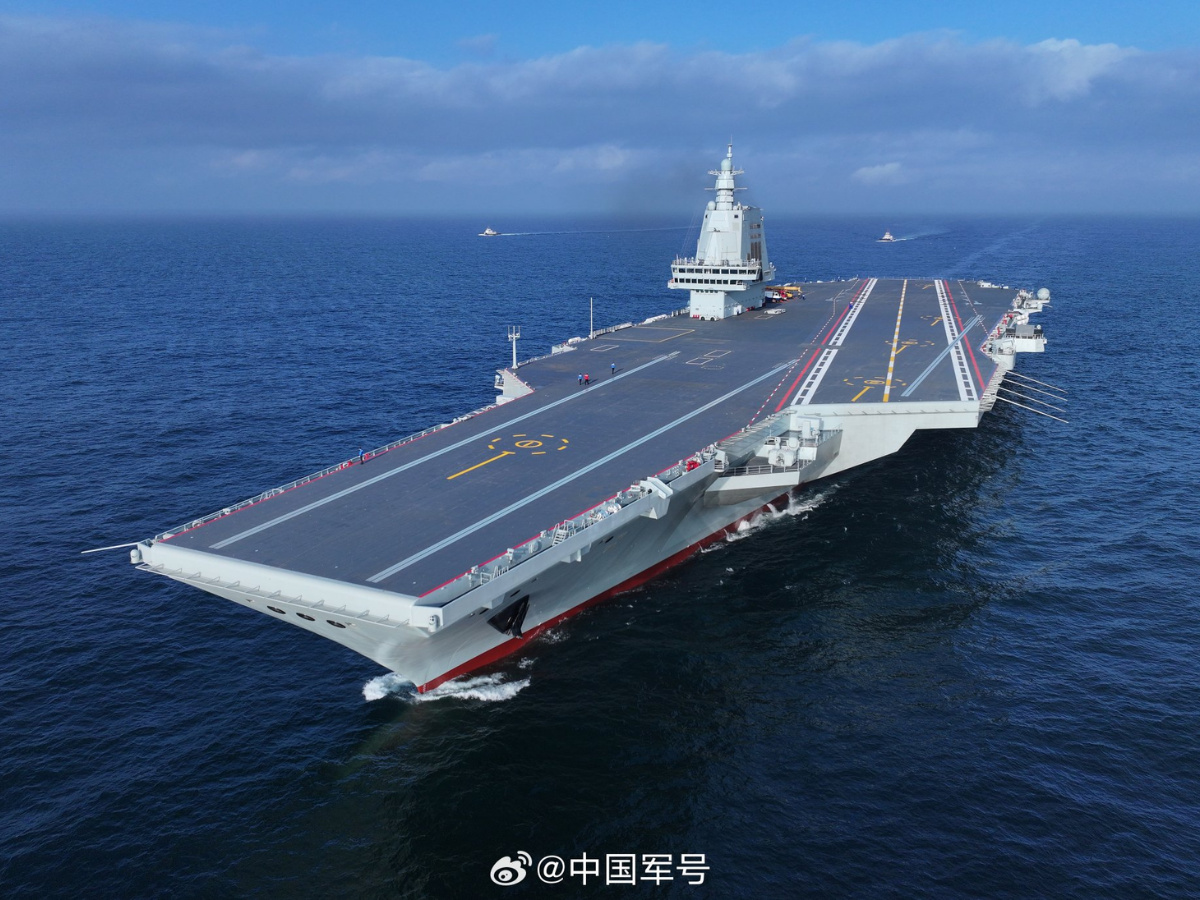


China Accelerates Modernization Of Its Navy With The New Aircraft Carrier Fujian, Set To Enter Service In 2025. CATOBAR Ship With Cutting-Edge Technology Challenges US Dominance In The Pacific.
China is about to reach a decisive milestone in its military and naval strategy. The Fujian aircraft carrier (Type 003), the most advanced ever built by the People’s Republic of China, is in the final testing phase and is expected to be incorporated into the Navy fleet by 2025.
With cutting-edge technology, such as electromagnetic catapults – previously exclusive to American Gerald R. Ford-class ships – the Fujian signals Beijing’s ambition to directly rival the United States in naval projection capability in the Indo-Pacific.
Cutting-Edge Technology Marks The Fujian As A New Symbol Of Chinese Naval Power
The Fujian is China’s first CATOBAR aircraft carrier with conventional propulsion. Its displacement exceeds 80,000 tons, and it features three electromagnetic catapults, a landing system for aircraft, and a continuous flight deck.
-
The U.S. Navy Conducts Submarine Tests in Idaho Lake to Detect Underwater Noises Hidden by the Ocean

-
Nuclear Submarine USS Alexandria Retired After 35 Years, Having Completed Over 1 Million Miles in Missions

-
MODEC Introduces New Hull Design for FPSO Gato do Mato to Produce Up to 120,000 Barrels of Oil Per Day in Brazil’s Pre-Salt Region
-
This Massive 12-Meter, 21-Ton Underwater Drone Can Operate Autonomously for Up to Five Days


These features enable the ship to launch and recover a wider range of aircraft, in operational conditions similar to those of the most modern American aircraft carriers.
The ship was launched in June 2022 at the Jiangnan shipyard and has since undergone eight sea trials, accumulating more than 100 days of testing.
In its latest phase, conducted in May 2025, the Fujian tested operations with the stealth fighter J-35, reinforcing that commissioning is near.
Aircraft Carrier Fujian Will Expand The Chinese Navy Air Capacity
The entry into service of the Fujian will allow the Chinese Navy to operate a varied range of embarked aircraft, including:
- J-15T fighter, a version adapted for catapult takeoff;
- Stealth fighter J-35, still in development;
- J-15D, electronic warfare version;
- AEW&C KJ-600 aircraft, specialized in early warning;
- Support helicopters and drones.
With this arsenal, China will make a qualitative leap in its maritime warfare doctrine, adopting a structure closer to US practices, which have led in naval power for decades.
A New Phase In Chinese Maritime Expansion
The entry into operation of the Fujian will mark the beginning of the so-called “era of three aircraft carriers” for China, which already operates the Liaoning and Shandong ships.
Both recently participated in unprecedented joint operations in the Pacific, surpassing the so-called “first island chain” and approaching strategic areas such as Guam, a US base in the Indo-Pacific.
These actions have raised alarms in Japan, Taiwan, and among US allies, who see Chinese naval modernization as part of a geopolitical expansion plan of Beijing’s influence in the region.
The Naval Race With The US Gains New Momentum
Today, the United States has 11 nuclear-powered aircraft carriers in operation, leading global maritime supremacy. With the advancement of the Fujian, and plans already underway for a fourth Chinese nuclear-powered aircraft carrier (Type 004), China is firmly entering the race for leadership in the Pacific Ocean.
Analysts point out that the consolidation of the Chinese fleet with large-capacity and autonomy ships alters the strategic balance in the region.
The Fujian, by adopting technologies previously considered exclusive to the West, represents a turning point in global naval dynamics.