






 Portuguese
  Spanish


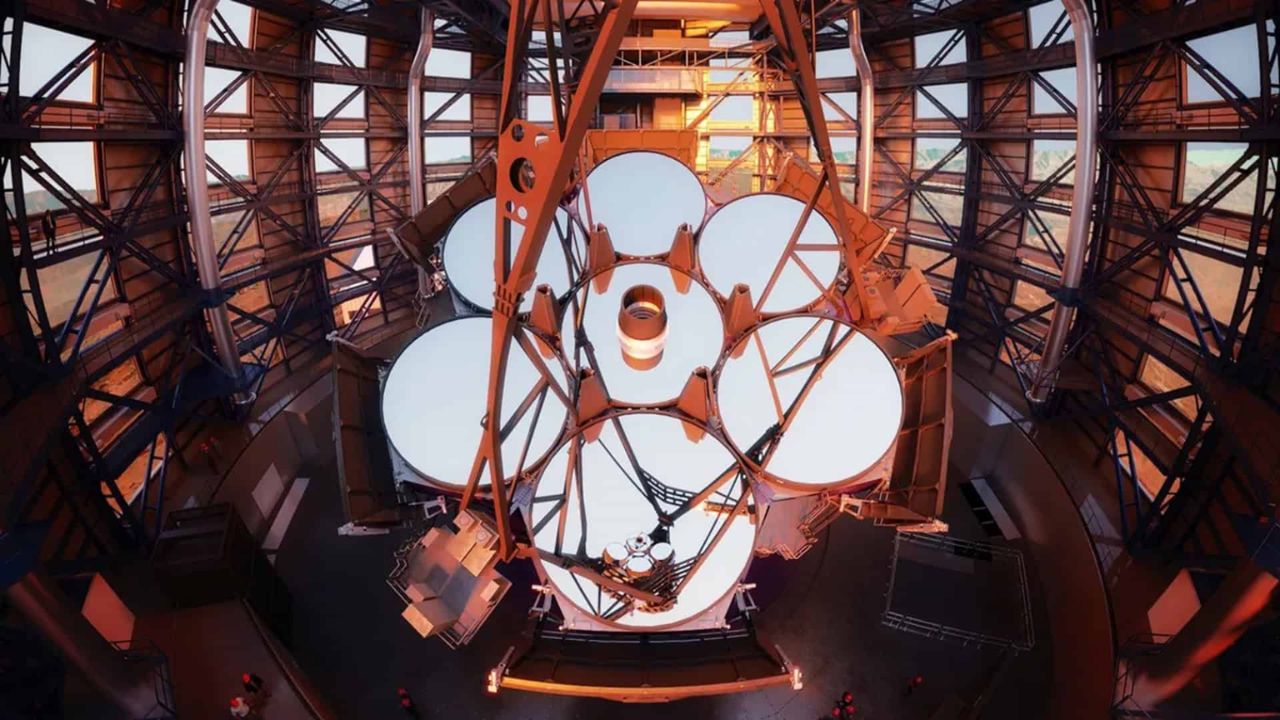

Giant Magellan Telescope will have unprecedented capacity to observe exoplanets and search for signs of life beyond the Solar System.
The search for Earth-like planets is expected to enter a new phase in the coming years with the advancement of the Giant Magellan Telescope, a project under development in the Atacama Desert, Chile. Created by an international consortium of 16 research institutions from seven countries, the observatory is designed to observe exoplanets with an unprecedented level of detail.
Scientists expect to significantly expand knowledge about worlds located beyond the Solar System and identify environments that may have conditions favorable to the existence of life. While new space missions are being prepared for the next decade, the gigantic ground-based observatory emerges as one of the most promising tools to overcome current limitations in the detection and analysis of smaller and cooler planets, similar to ours.
What makes the Giant Magellan Telescope so special?
A large portion of the exoplanets discovered in the last three decades have characteristics very different from those found on Earth. According to researchers, this occurs not only because of the diversity of existing worlds but also due to current technological limitations.
-
Plastic Waste from Beaches and Poor Communities in Kenya Transformed into School Desks, Replacing Wood in Classrooms and Turning Marine Litter into Durable Study Tables

-
Your Old Gmail Address Might Be Obsolete Soon: Google Introduces Feature Changing Account Usage.

-
Lost Fossil Found in Brazil Unveils 240-Million-Year-Old Reptile Predating Dinosaurs, Redefines Evolutionary Map and Highlights Southern Brazil’s Role in Understanding Crocodile and Dinosaur Ancestors

-
China to Drill 15 Kilometers into the Earth, Set to Break Russia’s Record for Deepest Man-Made Hole


In this context, the Giant Magellan Telescope was designed to expand astronomers’ observational capacity. The equipment will feature a primary mirror 25.4 meters in diameter, composed of seven circular segments.
The main highlights of the project include:
- Primary mirror of 25.4 meters;
- Participation of 16 scientific institutions;
- Cooperation among seven countries;
- Resolution ten times greater than the Hubble telescope;
- Four times greater capacity than the James Webb in certain observational aspects.
These characteristics will allow for more detailed analyses of extremely distant objects.


How does the observatory intend to photograph other worlds?
One of the most ambitious goals of the project is to obtain direct images of planets orbiting distant stars.
Although these images will not present details comparable to photographs of Earth seen from space, scientists believe that a few pixels will be enough to collect valuable information about these celestial bodies.
For this, the observatory will use advanced technologies capable of reducing one of the greatest challenges of ground-based astronomy: distortions caused by the atmosphere.
The constantly moving air interferes with the passage of light and impairs the sharpness of observations. To minimize this problem, high-speed computers work together with mirrors that continuously change their shape, correcting image imperfections in real-time.
Giant Magellan Telescope will feature unprecedented technology
Among the most important equipment planned for the observatory is the system called GMagAO-X. The tool uses 21,000 actuators controlled at speeds exceeding two thousand hertz to compensate for the effects of atmospheric turbulence.
Additionally, the equipment has a coronagraph, a device responsible for blocking the intense brightness of observed stars. This way, scientists can analyze only the light reflected by the planets orbiting these stars.

According to the project’s chief scientist, Rebecca Bernstein, the system will allow something unprecedented. As she stated, the instrument will be able to directly capture cold planets with dimensions similar to Earth’s for the first time.
“The GMagAO-X is a coronagraphic imager that works with extreme adaptive optics, which means it achieves an adaptive optics resolution even better than the telescope itself and takes direct images, literally observing planets orbiting around stars. It will be able to take direct images of cold Earth-sized planets for the first time,” reveals Bernstein.
Space missions will also aid in the new phase of research
The advancement of knowledge about exoplanets will not depend solely on the Chilean observatory.
In the coming years, the European Space Agency will launch two important scientific missions:
| Mission | Forecast |
| PLATO | Start of 2027 |
| ARIEL | 2031 |
According to researchers, each will have a specific function.
PLATO will be responsible for locating new exoplanets, while ARIEL will study in greater depth the atmospheres of these already identified worlds.
For IFLScience, Maximilian Günther from the European Space Agency stated that the PLATO mission represents a significant shift in the sector. According to him, the project will allow the discovery of planets with size and mass similar to Earth’s, as well as provide information about the age of the stars and the observed planetary systems.
“PLATO is a revolutionary mission that will not only find us new exoplanets, especially Earth-sized and mass exoplanets in one-year orbits, but will also tell us about the ages of the stars and these worlds. We will really have a paradigm shift in terms of our understanding of other worlds… this is extremely exciting!”
Search for signs of life gains reinforcement
Another important instrument of the observatory will be the Giant Magellan Telescope Consortium Large Earth Finder (G-CLEF), a system aimed at spectrographic analyses.
Its function will be to measure properties of exoplanets and investigate possible chemical indicators in their atmospheres.
The objectives include:
- Determine masses of Earth-like planets;
- Study atmospheres of distant worlds;
- Search for biosignatures;
- Support research on objects outside the Milky Way.
Rebecca Bernstein highlighted that the equipment will be the only high-resolution visible spectrograph planned for the initial phase of operation of the three large extremely large telescopes currently under development.
According to the researcher, the expectation is that the instrument will help identify substances like oxygen in the atmospheres of planets beyond the Solar System.
Construction advances in the Atacama Desert
While the scientific community awaits the start of operations, an important part of the infrastructure is already at an advanced stage. The seven main mirrors of the observatory have already been cast and various instruments are under development.
At the same time, preparations at the chosen site for the installation continue to advance. The observatory will be built in the Atacama Desert, a region recognized for its favorable conditions for astronomical observations.
Although there are still important steps ahead, the responsible team shows confidence in the scheduled timeline and hopes to overcome the final evaluations scheduled for 2027.

A new era for the study of exoplanets
In addition to the Giant Magellan Telescope, other initiatives are also expected to increase the number of discoveries in the coming years. Among them are new analyses of data collected by NASA’s TESS satellite and atmospheric observations conducted by the James Webb telescope.
For Joshua Roth, a researcher at Princeton University, the field is experiencing a moment of transformation. Instead of studying only isolated cases, astronomy is moving towards a phase marked by large-scale surveys capable of revealing patterns among thousands of worlds.
With more advanced equipment, unprecedented space missions, and large observatories coming into operation, scientists hope to better understand the diversity of planets existing in the galaxy.
In this scenario, the Giant Magellan Telescope appears as one of the most important tools to bring humanity closer to answering one of the oldest questions in science: how many Earth-like worlds might exist beyond our own?
With information from Olhar Digital and IFLScience


