





The magic lies in a machine that receives fresh concrete on one side and delivers, on the other, a ready track in the exact measure, guided by laser and GPS. Without joints, the slab becomes a single, stronger piece. But the secret of the good result starts much earlier, in the precise dosage of the mixture.
Giant pavers that spread, compact, and mold concrete in a single pass allow for the construction of up to about 5 kilometers of road per day in the United States. The equipment, known as a slipform paver, creates a continuous and jointless slab, designed to last decades and withstand the heavy truck traffic, being today a reference in large-scale concrete road construction around the world.
In the United States, concrete pavement, also called rigid pavement, accounts for a significant portion of the road network, around 30% according to industry entities, and is usually the choice for high-traffic highways. Before detailing how these machines work, it’s worth understanding why concrete is preferred in certain stretches and what makes this industrial process so precise, from soil preparation to mixture dosage, as we will see below.
Why choose concrete instead of asphalt
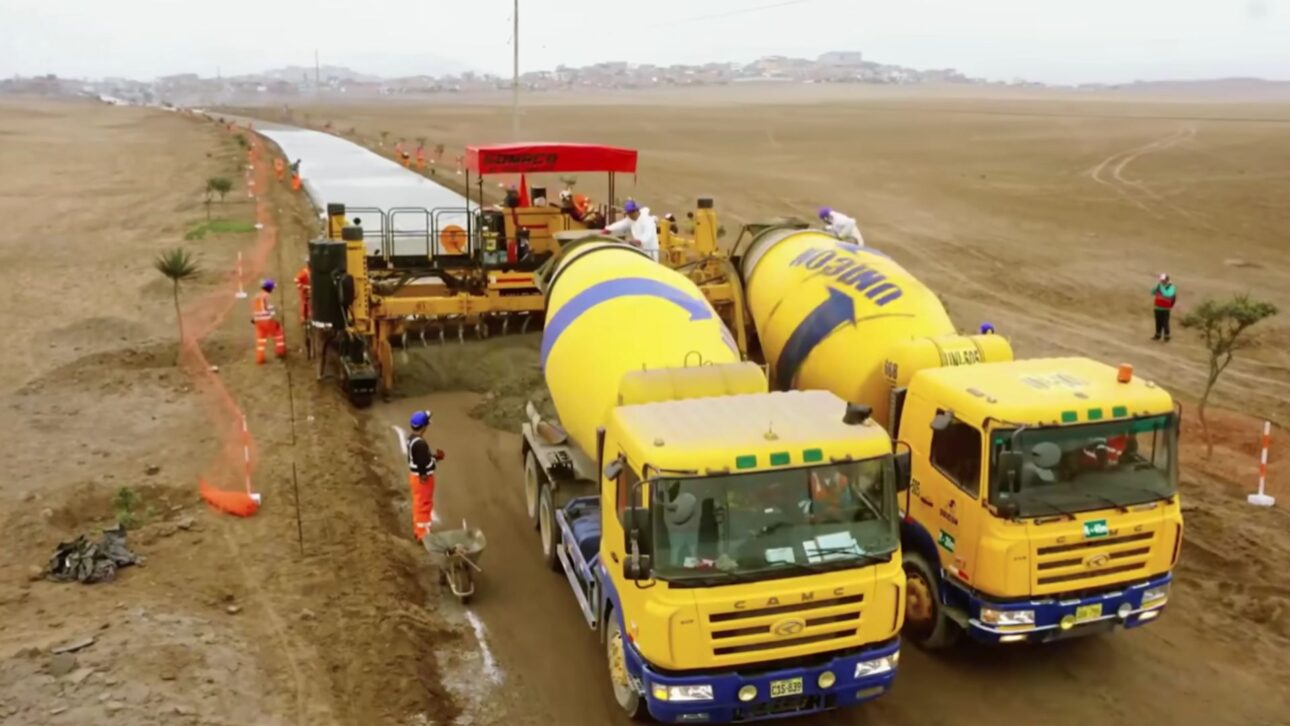
Concrete pavement tends to last much longer than asphalt, with an estimated lifespan of around 25 to 40 years, compared to about 15 to 20 years for asphalt, according to U.S. transportation departments, and also resists deformation caused by heat and truck weight better, making it suitable for heavy load corridors.
-
Sustainable Building Solutions Enhance Durability, Long-Term Savings, and Comfort in Home Construction and Renovation

-
Brazilian Fishing Couple Spends 4 Years Building Solar-Powered Floating Home on the Paraguay River, Now a Navy-Approved Vessel with Leisure Area and Tour Demand

-
While the World Opens New Airports and High-Speed Trains, Brazil Rushes to Complete Projects Stalled for 40 Years
-
Brazil Invests in Massive Waterway to Transport Soybeans by Barge, Reducing Costly Truck Reliance



Federal American studies cited by industry associations indicate that concrete highways last, on average, about two to two and a half times longer than asphalt ones.
On the other hand, it is important to maintain balance: concrete usually has a higher initial cost, the sensation of driving on it is less smooth than on asphalt, and any repairs can be more complex.
Therefore, the choice depends on the type of road, the traffic volume, and the available budget.
It All Starts with the Ground
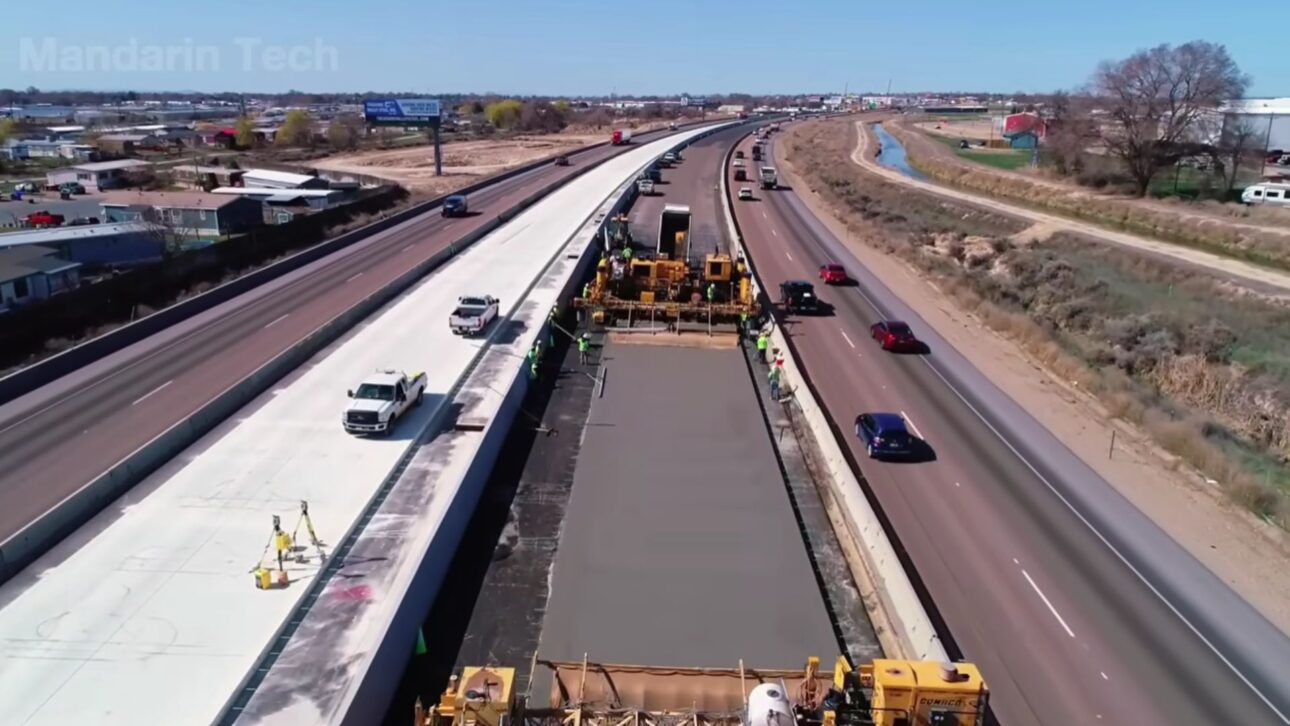
The foundation of a good concrete road lies in the preparation and compaction of the soil, which needs to be firm enough to support the slab and the weight of vehicles, in a process accompanied by heavy compacting rollers and water trucks that maintain the ideal moisture of the terrain so that the particles unite at the correct density.
After studying the layout and soil conditions, the team performs earthworks, installs underground networks and drainage systems, and then spreads a layer of compacted gravel, the sub-base, which helps distribute the surface weight to the ground.
Technicians monitor each stage with compaction meters and laser leveling equipment, ensuring everything stays within project tolerances.
Only then is the road ready to receive the concrete.
Precise Dosage at the Plant
It is at the concrete plant that the final quality begins to be defined.
All the concrete is produced in an industrial batching plant, where aggregates like gravel and sand, water, and additives are weighed and measured with extreme precision, following a previously calculated mix, before being mixed and sent to the mixer trucks, in a control that makes all the difference in the track’s strength.
This care with dosage is precisely what separates a reliable construction from a fragile structure, a principle that applies to both large highways and any concrete work.
Additives such as superplasticizers and accelerators are measured separately to avoid errors, and the ready concrete has a window of only one to two hours before it starts to harden, so the truck drum keeps spinning during transport, preventing the mix from separating or setting prematurely.
The Machine That Brings the Road to Life
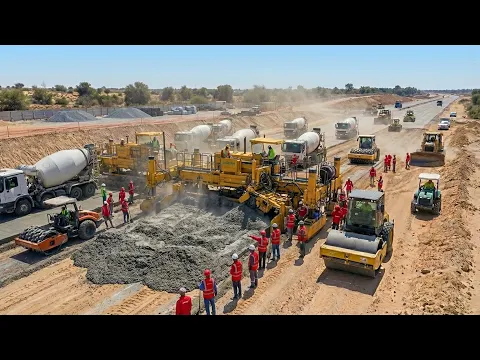

The heart of the entire operation is the slipform paver.
Upon receiving the concrete, this machine spreads, vibrates, and molds the mixture to the exact width, thickness, and height of the project in a single pass, eliminating the need for subsequent rolling or manual finishing and producing a continuous, seamless slab, guided by laser sensors and GPS or three-dimensional guidance systems.
During paving, the machine itself automatically inserts steel bars, called dowel bars, into the middle of the concrete thickness along the width of the track.
These bars are essential for transferring the load between adjacent slabs and reducing the occurrence of cracks at the joints.
As the equipment advances in continuous motion, it does not leave the so-called cold joints between one load and another, creating a monolithic, stronger, and more durable structure.
Curing, joints, and traffic release
After being molded, the concrete still goes through decisive stages.
Right after paving, a curing compound is sprayed on the surface to retain moisture and allow the concrete to gradually gain strength, and a few hours later, special saws cut joints at regular intervals to control where the material will expand and contract with temperature variations, preventing random cracks.
These joints are then cleaned and filled with sealant, usually polyurethane or silicone, to prevent the entry of water and debris, which protects the underlying base layer.
Finally, the road receives signage and is closed for about seven days, the time needed for the concrete to reach the designed strength.
Before the official opening, engineers conduct strength and flatness tests, ensuring the road is ready for use.
High technology and the contrast with the manual method
Not every place in the world has this level of automation.
While in the United States slipform pavers are common, in many developing countries road construction still heavily relies on manual labor, with workers spreading the mixture with shovels and screeds and compacting with portable vibrators, in a much slower process dependent on the team’s experience.
In this manual method, it is more difficult to achieve high precision in leveling and flatness, especially in long stretches, as there are no sensors and guidance systems of modern machines.
Even so, this technique continues to be used in remote areas or projects with limited budgets, where access to advanced equipment is restricted.
The contrast highlights how technology can transform the speed and quality of infrastructure, even though mastering the technique remains essential in any scenario.
The construction of concrete roads combines, in a single process, soil engineering, mixture chemistry, and cutting-edge automation, all aimed at delivering tracks capable of withstanding decades of heavy traffic.
Slipform pavers symbolize this advancement, by molding a continuous slab with centimeter precision and at an accelerated pace.
More than an engineering curiosity, understanding how these roads are born helps to appreciate what is under our tires every day, and to remember that in concrete, the final result depends as much on the machine as on the rigorous control of each step.
And you, did you have any idea how concrete roads are constructed and the difference between them and asphalt? What do you think about the use of this type of pavement on highways? Leave your comment, share your opinion, and help spread the article to those interested in engineering, construction, and infrastructure.


