Portuguese
  Spanish


They emerge from the top of storms and rise towards space, instead of descending to the ground. They last milliseconds and are almost never seen from the surface. From orbit, however, astronauts have captured these colorful flashes, which help science unravel how lightning is born and protect aviation.
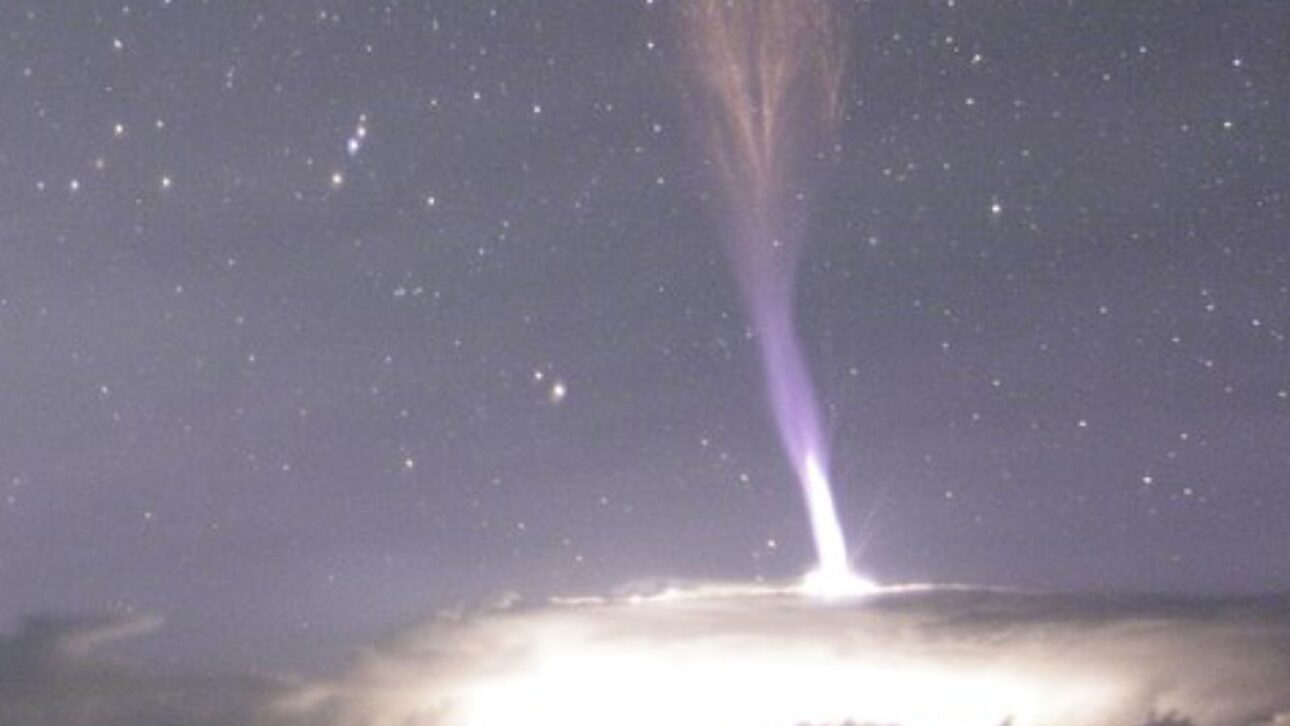
There is a type of lightning that completely defies the image we have of storms. NASA astronauts have captured from the International Space Station rare lightning that shoots upwards, towards space, instead of falling to Earth, like the giant jet photographed by astronaut Nichole Ayers, high-atmosphere electrical phenomena almost impossible to see from the ground.
The most talked-about image was captured on July 3, 2025, by NASA astronaut Nichole Ayers, while the station was passing over a large storm in northern Mexico and the southwestern United States. Initially, she thought she had photographed a sprite, but NASA later confirmed it to be a giant jet, an even rarer phenomenon. Next, we explain what these upward lightning are, why they are so difficult to observe, and what science gains by studying them from space.
Lightning that rises instead of descending
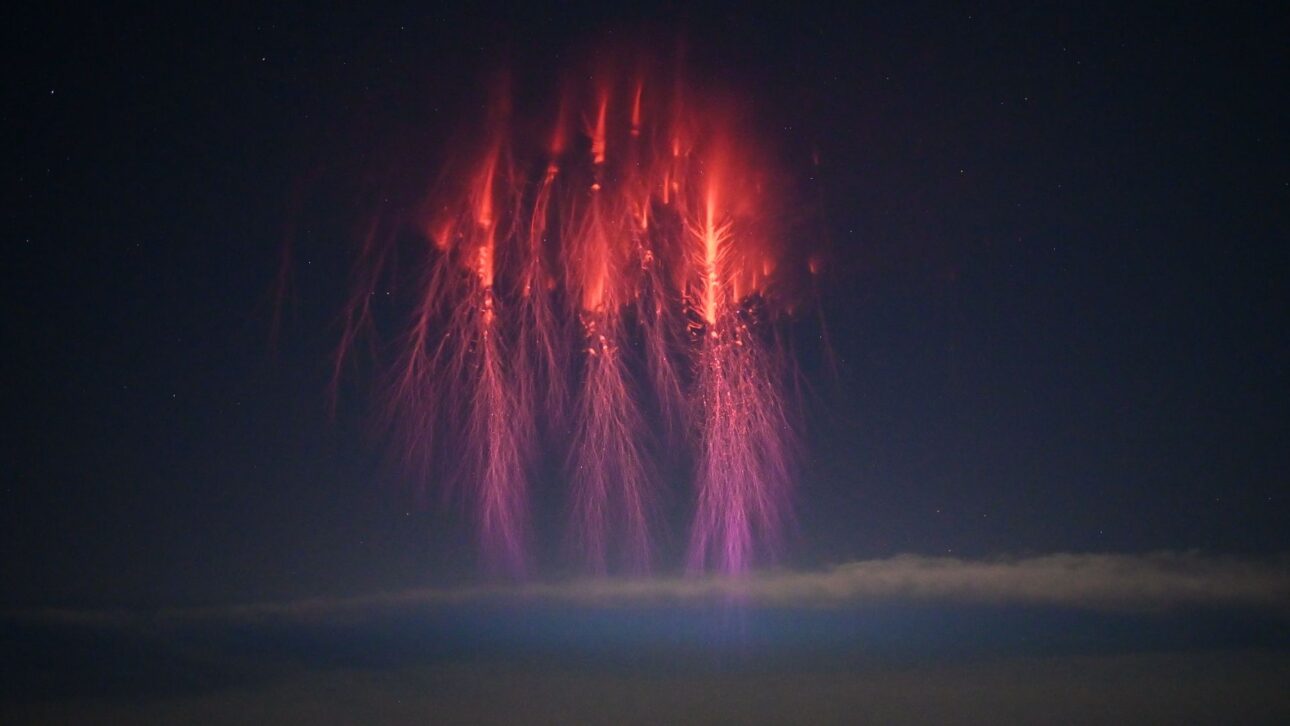
Unlike common lightning, which goes from cloud to ground or between clouds, these phenomena are brief flashes that appear above storms and shoot upwards, towards the upper atmosphere, receiving the technical name of transient luminous events, or TLEs in the English acronym, a family of lightning little known to the general public.
-
Drill Uncovers Freshwater Rivers Hidden Beneath the Ocean Floor

-
3,000-Ton, 81-Meter Attack Submarine Begins Sea Trials, Equipped with Heavy Torpedoes and Anti-Ship Missiles

-
Boat Made from 10 Tons of Plastic and 30,000 Discarded Flip-Flops Sails Along African Coast, Serving as a Floating Classroom on Ocean Pollution
-
Welder Discovers 16th-Century Diamond Ring in England After 7 Hours with Metal Detector; Gold Jewel Linked to Edward I Pattern Auctioned for £17,000




The TLEs encompass various types with names that seem to come from a legend but describe real electrical activity high in the atmosphere: red sprites, blue jets, halos, ELVES, and giant jets.
Each forms at a different altitude range and has its own appearance, but they all share the same characteristic of emerging far above the clouds, in a territory that traditional weather maps don’t even reach.
What are sprites and giant jets
It’s worth understanding the difference between the two phenomena mentioned.
Sprites usually appear as reddish flashes, resembling jellyfish, in the mesosphere, about 50 to 85 kilometers in altitude, while giant jets are discharges that rise from the top of a storm cloud towards the upper atmosphere, forming a kind of temporary electric bridge between the storm and nearby space, potentially reaching nearly 90 kilometers in height.
It was exactly this difference that led to the correction in Nichole Ayers’ photo: what seemed like a sprite was, in fact, a giant jet, even rarer.
Giant jets occur when turbulent conditions at the top of very intense storms allow the electrical discharge to escape upwards.
Due to their shape, they often resemble columns or branched structures, like tree branches, projecting towards the sky.
Why only from space can you see well
Capturing these lightning bolts from the ground is almost a lottery.
From the surface, these flashes are very difficult to capture because clouds block the view, the events last only fractions of a second, and the sky must be clear above a distant storm, a rare combination of conditions that makes most of them go unnoticed.
The International Space Station changes this game.
Orbiting at about 400 kilometers in altitude, it offers astronauts and instruments a clear view of the top of storms, precisely where the weather stops being just rain and wind and begins the strange electrical story of the upper atmosphere.
Therefore, the same storm systems can be observed repeatedly until a rare event finally appears.
The station’s storm laboratory
A central instrument is the Atmosphere-Space Interactions Monitor, known by the acronym ASIM, built for the European Space Agency and installed on the exterior of the station’s Columbus module in 2018, which studies lightning, transient luminous events, and the so-called terrestrial gamma-ray flashes, functioning as a true storm laboratory in orbit.
The ASIM uses cameras, photometers, and X-ray and gamma-ray sensors to capture flashes too fast for many ground-based instruments.
Photography taken by astronauts has also become a scientific tool: a timelapse from the station, dated June 26, 2024, captured a large sprite, and ESA astronaut Andreas Mogensen photographed a red sprite with the Thor-Davis experiment camera, capable of recording the equivalent of 100,000 images per second, the speed needed to catch something that flashes and disappears in an instant.
A clue to understanding lightning
But why so much effort in chasing these lightning flashes?
One of the reasons is that they can help scientists understand how lightning begins, a surprisingly persistent mystery for such a familiar phenomenon, as the first confirmed recordings of these events high in the atmosphere only came in the late 1980s, making this field of research relatively young.
According to NASA, ASIM data has helped show how discharges at the tops of storms can generate ELVES, which are rapidly expanding rings of light near the lower ionosphere, and influence this layer of the atmosphere.
Since the ionosphere helps carry certain radio signals, a flash that almost no one sees can still have a connection with communications on Earth, which reinforces the scientific value of each record.
What this means for aviation
These phenomena also have practical implications for those who fly.
Some storms produce terrestrial gamma-ray flashes, bursts of high-energy radiation associated with lightning, which, according to NASA, can expose aircraft, their electronic equipment, and passengers to elevated levels of radiation, which is why mapping these events is considered important for air safety.
This does not mean that every storm is a hidden radiological threat, but it gives pilots, aircraft manufacturers, and meteorological agencies good reasons to be concerned about what happens well above the tops of clouds, especially near very strong storms.
Giant jets, in particular, may be associated with severe turbulence.
To expand monitoring, small satellites, like the CubeSat Light-1 from Japan’s space agency, have already been launched from the station to test the detection of these radiation flashes.
The images of upward lightning captured by NASA astronauts from the International Space Station are much more than beautiful photographs from space.
They connect the storm we see from the window to topics like aviation safety, atmospheric chemistry, radio signals, and the still incomplete science of how lightning is born.
Each sprite or giant jet captured from above helps piece together a puzzle that has intrigued scientists for decades, showing that even in something as common as a storm, there is still much mystery to unravel.
And you, had you heard about these lightning bolts that shoot upwards, towards space? What did you think of these rare images captured from the International Space Station? Leave your comment, share your opinion, and help spread the article to those interested in science, space, and natural phenomena.