Portuguese
  Spanish



Study Reveals Unprecedented Potential to Transform Unproductive Areas into Clean and Sustainable Energy Hubs in the Country
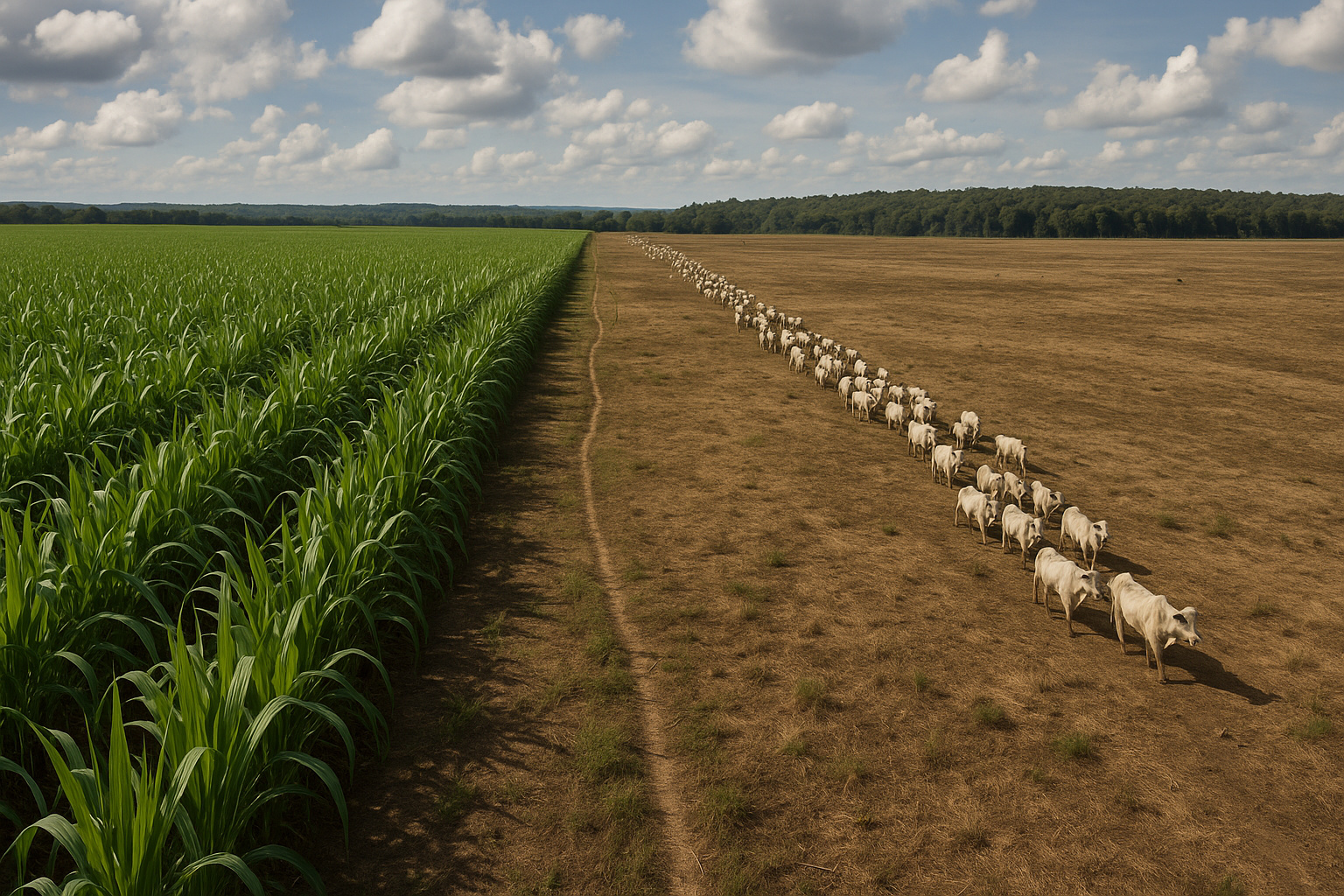
Brazil has about 100 million hectares of degraded pastures, according to data from the Institute of Energy and Environment (IEMA) released in August 2024.
These areas, with low livestock productivity, can become a new frontier for biofuel production and other clean energy sources.
According to the study “Biofuels in Brazil: Aligning Energy Transition and Land Use for a Carbon-Negative Country”, the potential can double national biofuel generation by 2050.
-
Brazil Advances with JetBio’s Megaproject to Build the World’s Largest Ethanol-Based Sustainable Aviation Fuel Plant, Aiming to Become a Global Exporter

-
Brazil on Track for Record 40.7 Billion Liters of Ethanol in 2026/27 Season, Driven by Corn Ethanol
-
Petrobras Approves $1.2 Billion Refinery in Brazil to Produce Aviation Fuel and Diesel from Plants
-
US$ 7 billion, green hydrogen, and steel with up to 95% less CO₂: the first green steel plant on the planet emerges in Sweden and targets Brazil as the next chapter



Thus, Brazilian farmland can become the new green pre-salt, capable of driving the energy transition and strengthening the sustainable economy.
Degraded Pastures Become Sustainable Opportunity
Today, a large portion of Brazilian pastures produces below expectations.
Engineer Felipe Barcellos e Silva, a researcher at IEMA, explains that 25 to 30 million hectares can generate clean energy without affecting livestock.
He states that part of the land should be reforested, while another remains productive pasture and the rest can be used for biofuels and food.
In this way, converting unproductive areas can increase biofuel production by up to 221 million tons of oil equivalent (Mtoe).
This volume would exceed the current level of 112 Mtoe, representing a significant leap towards carbon neutrality, without requiring new deforestation.
Efficient Crops and Environmental Protection
To ensure sustainable progress, the study reinforces the need to invest in more productive crops, such as macaúba, and in technologies that enhance fuel yield.
Additionally, it recommends public policies to monitor land use, avoiding impacts on indigenous, quilombola, or environmental conservation areas.
According to the survey, Minas Gerais, Mato Grosso, Bahia, Mato Grosso do Sul, and Goiás concentrate more than half of the suitable lands for energy production.
Minas leads with 10.6 million hectares (19%), followed by Mato Grosso (7 million, 12.6%) and Bahia (6.9 million, 12.4%).
These figures indicate that production can grow without compromising food security.
Macaúba, the Star of Biofuels
The macaúba, a native palm tree of Brazil, stands out as one of the most promising crops.
According to Embrapa, one hectare can produce 4,000 kg of oil, while soybeans only yield 400 kg.
This productivity positions macaúba as an ideal alternative for biodiesel, green diesel, and sustainable aviation fuel (SAF).
Moreover, the study shows that soy cannot maintain its position as the main source of vegetable oil due to low efficiency.
Therefore, a gradual replacement with macaúba, corn, and sugarcane is essential to meet national energy demand by 2050.
As a result, the country can advance without deforestation and maintain environmental balance.
Diverse Production Strengthens Energy Security
Barcellos e Silva emphasizes that diversifying energy sources is crucial for Brazil’s supply.
He explains that mixing energy matrices reduces risks, accelerates the green transition, and boosts the low-carbon economy.
Currently, gasoline and diesel already contain about 15% biofuels, and the trend is for an increase in the coming years.
Additionally, the combined use of raw materials strengthens social sustainability, allowing advances without affecting traditional communities or environmental reserves.
This way, the country can grow in a balanced and responsible manner, uniting economy, energy, and preservation.
How the Study Was Conducted
The team from IEMA and the Climate Observatory analyzed land use to expand the production of sugarcane, corn, soybeans, and macaúba by 2035.
The survey also projected scenarios for supply and demand for biofuels until 2050, considering productivity, land availability, and avoided emissions.
The results indicate that Brazil can double national production, provided it prioritizes high-yield crops and sustainable management.
According to the report, the country has real conditions to become a global green powerhouse, uniting clean energy, food security, and environmental protection.