






 Portuguese
  Spanish


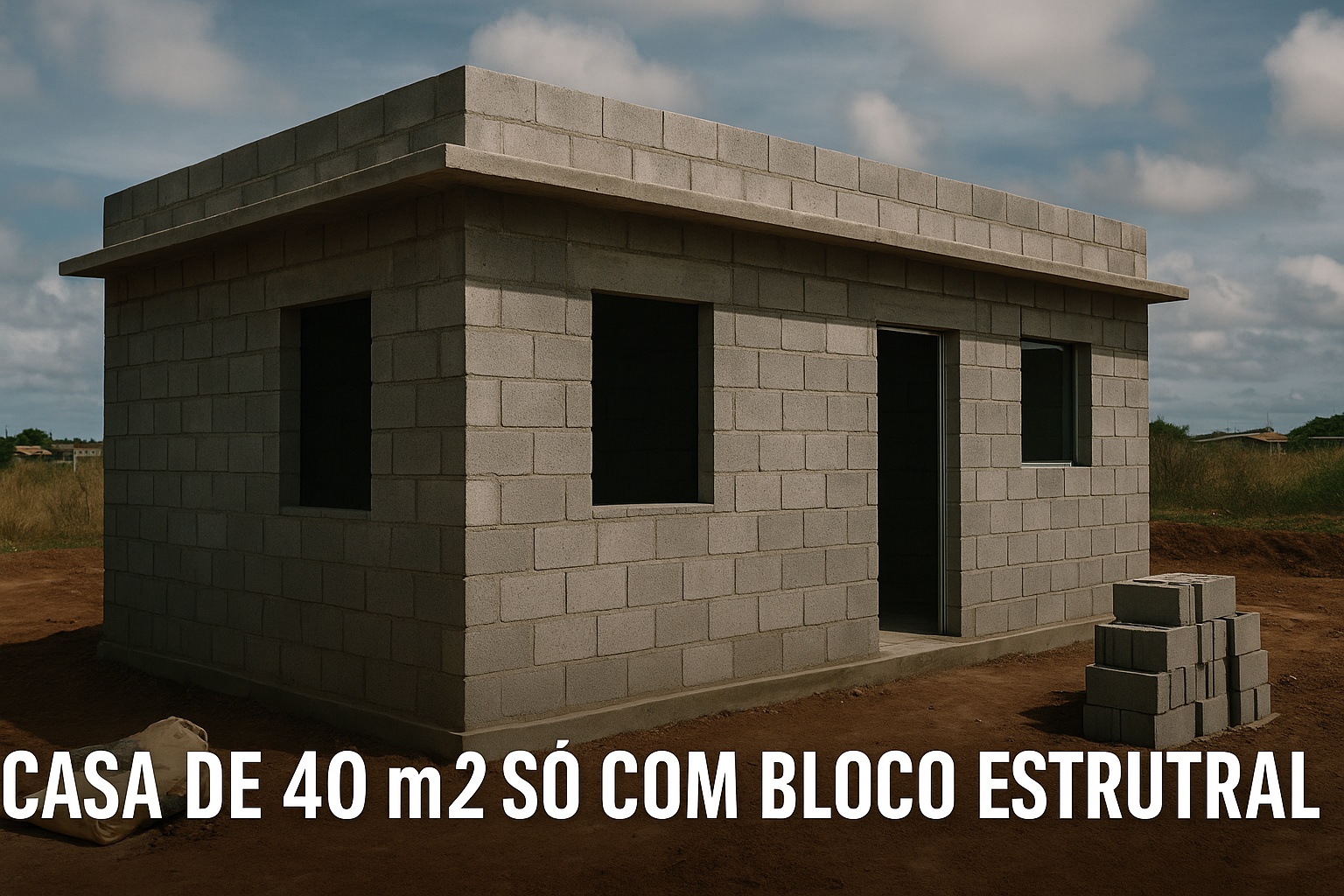


See How Much It Costs to Build a 40 m² House with Structural Concrete Block, Without Plaster, with Fast Work, Low Price, and Minimalist Finishing.
Building with structural concrete block has ceased to be a technique restricted to larger projects and has started to dominate small residential projects in Brazil. The simplicity of the material, the speed of execution, and the lower final cost have attracted those who wish to build quickly, with less waste and without relying on layers and layers of traditional finishing.
For those considering building a single-story house of 40 m², this method has become an alternative that combines economy, durability, and a contemporary look, especially when the project opts for exposed finishing, without plaster and without seam compound.
The question, however, remains the most searched: how much does it really cost to build a 40 m² house using only structural block? The answer involves materials, labor, specific techniques, and a change in mindset in the construction industry.
-
Affordable Housing Project in Brazil’s Mato Grosso Aims for 700 Deliveries and $34 Million in 2026, Outpacing Major Developers in High-Demand Areas

-
Brazil’s Largest Port to Accommodate Bigger Ships by October as Ibama Approves Non-Explosive Removal of Hidden Rocks and Sediments
-
Mexico Develops 3D-Printed Concrete from Corn Waste, Cutting Emissions by 70% and Reducing Construction Waste by 90%
-
Traditional Mortar to Decline by 2026: ACIII-E Solution for Large Porcelain Tiles Offers Better Adhesion and Reduces Risk of Loose Pieces in Floors and Facades


The System That Eliminates Columns, Beams, and a Large Part of the Wood
The structural block is different from the common block. It is designed to bear load, replacing traditional columns and beams. This means that the masonry itself becomes the structure of the house.
The blocks have specific internal cavities, standardized alignments, and fittings that allow the passage of rebar and grout, a type of fluid concrete that strengthens strategic points.


Since the system is industrialized, everything is planned in advance: wall heights, door openings, window placements, and load distribution. This planning drastically reduces improvisation, one of the largest hidden costs in Brazilian construction.
The absence of plaster is another distinguishing factor. When well set, structural blocks leave the wall ready to receive only acrylic paint, texture, or sealer. In addition to being a modern visual, it eliminates one of the longest phases of construction.
How Much Does It Cost to Build a 40 m² House with Structural Block
Prices vary by region, labor, and finishing, but there is a consolidated standard in the country based on manufacturers, specialized construction companies, and market data.
For the method with exposed walls (without plaster), the average cost ranges from: R$ 1,800 to R$ 2,600 per m²
This places a 40 m² house in the range of:
R$ 72,000 to R$ 104,000
This amount includes:
• foundation
• structural masonry
• grout and rebar
• roofing
• electrical and plumbing installations
• simple ceramic flooring
• aluminum doors and windows
• painting or texture directly on the blocks
When compared to traditional masonry, which generally costs from R$ 2,500 to R$ 4,000 per m², the difference is clear. The structural block reduces time, labor, and waste, resulting in direct and predictable savings.
Why the Structural Block Reduces the Final Cost So Much
The secret lies in the elimination of stages.
A conventional construction requires:
• wooden forms
• extensive rebar
• concreting of columns and beams
• thick mortar
• plaster
• thin compound
• painting
In contrast, the structural block transforms all of this into a continuous process: raising walls, reinforcing strategic points, and applying light finishing. The construction no longer depends on long curing periods and the heavy sequence of plastering.
The time gain is evident. A small crew can raise the structure of a 40 m² house in just a few days, speeding up the entire project. In many cases, the total timeframe is between 20 and 45 days, depending on the finishing.
The Exposed Aesthetic and Minimalist Style That Conquered the Market
The exposed structural block is not just a technical choice but an aesthetic one. Brazilian architects have been exploring the gray look as a base for modern and minimalist projects.
With proper lighting, matte paint, or fine texture, the walls gain a contemporary look. It’s also possible to combine the block with wood, black metal, or polished concrete, creating a compact and sophisticated feel.
This style appeals to those seeking a low-cost project but with a current visual signature—something very common in studios, kitnets, and country houses.
Thermal Performance and Durability
The structural block has excellent mechanical resistance and low maintenance needs. It does not suffer from termites, does not rot, and has good durability even in humid areas. Additionally, walls of 14 cm or 19 cm offer good acoustic insulation and reduced heat transmission.
To further enhance thermal performance, many projects incorporate reflective blankets on the roof, cross ventilation, and deeper eaves, which are simple and inexpensive solutions.
Electrical and Plumbing Installations: How It Works Without Plaster
Installations are made directly in the internal channels of the blocks or through exposed overlap, using painted metal or PVC conduits. This style is commonly used in industrial lofts and American constructions. The result is practical, easy to maintain, and avoids breaking walls in the future.
Lighter and Faster Foundations
A structural block house generally uses:
• slab
or
• beam foundations with reinforced subfloor
Since the structure is distributed throughout the entire wall, the weight is more uniform, reducing the risk of differential settling. The foundation becomes simpler and cheaper than in structures with concentrated columns.
Where the Structural Block is Most Worth It
The method is especially advantageous for:
• small houses
• residential annexes
• kitnets
• studios for rent
• external offices
• small businesses
On flat land, efficiency is even higher, allowing for quick, clean projects with predictable costs.
A Solution That Should Grow Even More in Brazil
With the rising cost of conventional materials, the search for speed, and the need to avoid waste, the structural block has become one of the most solid alternatives in contemporary construction.
It delivers what the modern consumer wants: low price, speed, durability, and current aesthetics.
For those looking to build 40 m² at a lower cost, this method is one of the most competitive solutions available in the country, a union between structural simplicity and intelligent architecture.





2.600,00 é custo de obra de prédio de luxo, MCMV em muitos municípios o preço final com o terreno incluído a Caixa não paga isso!
Quisera eu ter posses e poder doar uma casinha dessa todo mês, para quem precisa. Sei que não resolveria o problema do mundo,mas levaria minha alma.
Que Deus te abençoe e te dê posse, e eu entraria em uma doada por vc. Amém 🙏💝
Abençoado seja o seu desejo! Meu objetivo tb é esse, e breve conseguiremos irmão 🙏
A minha está sendo feita com bloco estrutural. O Radier de 100m2 com piso polido e o esgoto já estão prontos!
Será com bloco aparente invernisado, hidráulica e eletrica aparente.
Vamo que vamo!
Com relação a elétrica e hidráulica faço conforme subo as paredes, requer um pouco mais de tempo e atenção porém não fica a marca dos cortes nas paredes
Boa tarde Fábio, trabalho com construção civil e se quer um conselho, você pode embutir a sua hidráulica e sua elétrica sem precisar quebrar o bloco e sem aumento de custo, tenho certeza de que ficaria bem bonito sua casa, tudo de bom.
Pois é… vou deixar aparente para ficar com estilo industrial.
“envernizado”