Portuguese
  Spanish


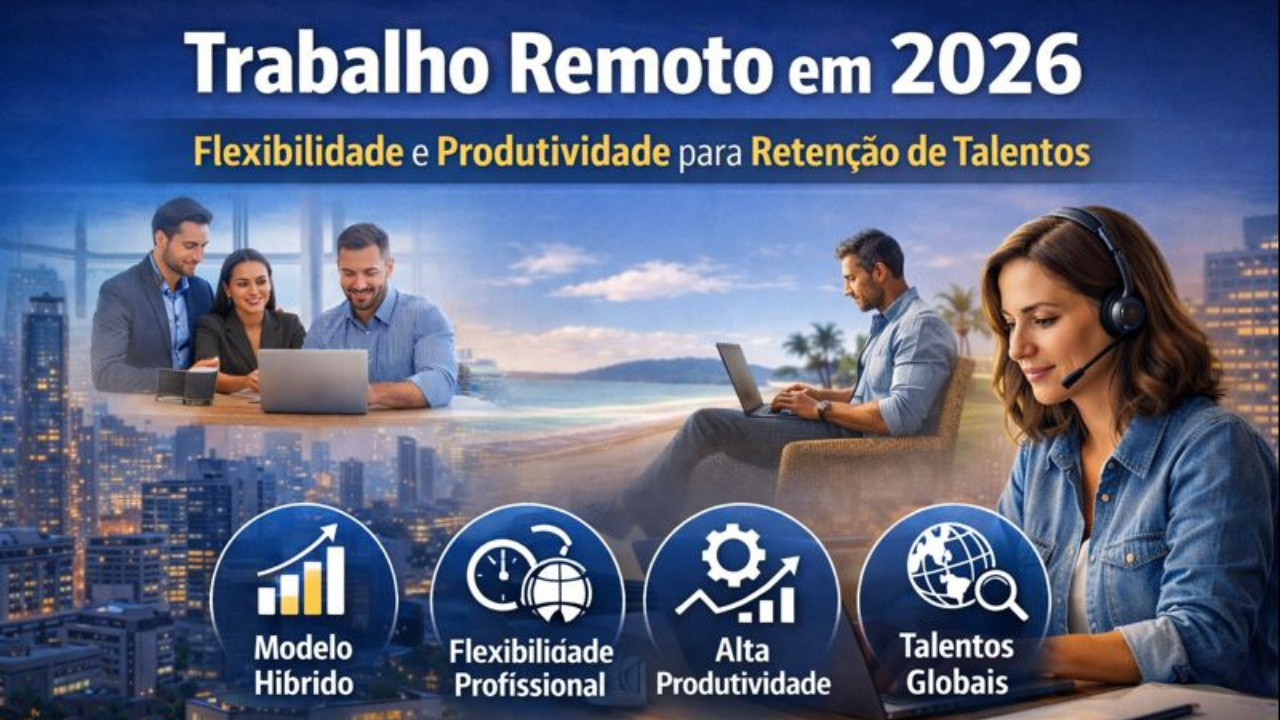


Companies Bet on Remote Work and Hybrid Model in 2026 to Increase Productivity, Professional Flexibility, and Talent Retention.
Remote work solidifies in 2026 as one of the main strategic axes of the global labor market, impacting companies, professionals, and management models.
Organizations in different sectors, both in Brazil and abroad, now face a structural decision: to maintain mandatory return to offices or to adopt the hybrid and remote model as a permanent operational basis.
This movement occurs in light of recent data showing clear gains in productivity, improvement in quality of life, and direct effects on talent retention, driving a profound transformation in corporate culture.
-
Brazilian Startup Turns Coffee Grounds into Plant-Based Leather, Cutting Water Use by Over 50 Times for High-Impact Sustainable Fashion

-
Eco Invest Auction Aims to Unlock $10 Billion in Investments, Focusing on Green Fertilizers, Critical Minerals, Batteries, and AI for Clean Industry in Brazil

-
Half of Brazilians Prefer Lower Taxes with Private Health and Education, While 44% Opt for Higher Taxes for State-Provided Services, Datafolha Survey Reveals

-
Brazil’s Most Expensive Toll Rises to R$ 40.60 on Route from São Paulo to the Coast, Nearly Matching Bus Fare to Santos




Over the past few years, companies have begun to reorganize their operations with distributed teams, supported by technology, performance metrics, and professional autonomy.
What was once seen as a specific benefit has thus become a strategic response to challenges such as engagement, competitiveness, and access to qualified talent.
Global Data Challenges Mandatory Return to Offices
Recent research reinforces that the full return to the office contradicts the perception of most professionals.
A survey by Gallup reveals that 57% of workers in a hybrid model point to the imbalance between personal and professional life as the biggest challenge when flexibility is reduced.
At the same time, data from Hrstacks indicates that 90% of professionals working remotely around the world consider themselves as productive or more productive than they would be in a solely in-person environment.
This contrast reinforces that the discussion has shifted from operational to strategic.
Financial Results Reinforce the Viability of Remote Work
The financial performance of large companies also supports the consolidation of remote work.
Nubank, for example, reported a net profit of US$ 637 million in the second quarter of 2025, with an annualized return on equity (ROE) of 28%.
The results were achieved with teams operating in a widely distributed manner, evidencing that productivity and efficiency do not depend on constant physical presence.
This type of result strengthens the perception that professional flexibility can coexist with high performance and sustainable growth.
Professionals’ Preferences Solidify the Hybrid Model
Studies indicate that resistance to complete return to offices is not isolated. According to McKinsey, four out of five professionals who worked in a hybrid model over the last two years wish to maintain it.
In Brazil, a survey conducted by the University of São Paulo in partnership with FIA Business School shows that 94% of professionals in remote work report significant improvement in quality of life.
This factor is directly connected to talent retention, a central theme for companies facing a shortage of qualified labor.
Results-Based Management Replaces In-Person Supervision
One of the main changes observed in remote work is the transformation of leadership models.
McKinsey indicates that companies that migrated to results-based evaluations recorded a 27% increase in engagement and 24% in operational efficiency.
This movement reduces dependence on in-person supervision and strengthens cultures based on trust, clarity of goals, and autonomy, fundamental elements for sustaining productivity in hybrid and remote environments.
On-Demand Squads Gain Ground in Organizations
Another relevant trend for 2026 is the gradual replacement of fixed teams by on-demand squads.
Instead of expanding permanent structures, companies are integrating specialists as needed for specific projects.
This model enhances professional flexibility, accelerates deliveries, and allows for greater adaptation to market changes, in addition to optimizing operational costs.
Asynchronous Communication Redefines Productivity
With the consolidation of remote work, asynchronous communication gains prominence.
Project management platforms allow teams to operate at different paces, reducing dependence on constant meetings.
This approach then decreases interruptions, improves focus, and contributes to sustainable gains in productivity, especially in distributed environments.
Mental Health Becomes a Performance Indicator
Thus, mental health emerges as one of the main indicators of corporate performance.
The U.S. Department of Health and Human Services points out that 76% of workers reported at least one symptom of a mental health problem, while 84% associated these impacts with poorly structured working conditions.
In this scenario, remote work and the hybrid model emerge as tools to reduce stress, increase autonomy, and improve well-being.
Professional Flexibility Boosts Talent Retention
<pThus, the relationship between professional flexibility and talent retention is direct.
A survey by Harvard Business School indicates that 40% of professionals would accept a salary reduction of at least 5% to maintain remote work.
Additionally, Buffer reveals that 98% of remote workers wish to continue in this model throughout their careers, reinforcing flexibility as a competitive differential.
New Standard Redefines the Future of Work
<pThus, the consolidation of remote work in 2026 marks a new standard of professional expectations.
When well-structured, flexibility increases engagement, strengthens productivity, and becomes one of the main pillars of talent retention.
In light of this scenario, companies that treat the hybrid model as a strategy, rather than a concession, tend to build more sustainable, competitive environments aligned with the demands of the future of work.
See more at: Home Office in 2026: Why Flexibility Ceased to Be a Benefit and Became a Strategy?