Portuguese
  Spanish


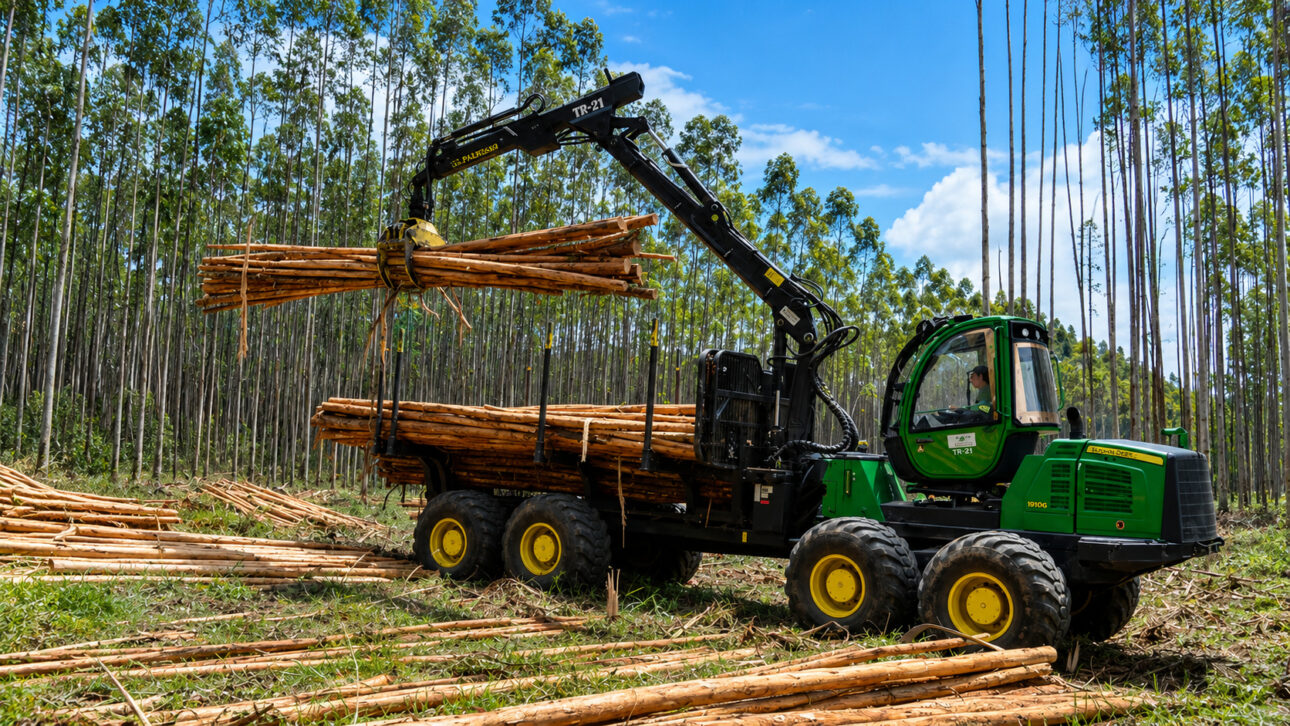
With the capacity to transport up to 19 tons of logs, the John Deere 1910E forwarder faces mud, slopes, and narrow trails to connect forest harvesting to the pulp industry.
Before the wood reaches paper, pulp, panel factories, or sawmills, it needs to overcome a less visible stage: leaving the forest interior. This is where machines like the John Deere 1910E come in, a forest forwarder designed to collect cut logs in the field and transport them to transshipment points, where larger trucks take over the journey.
According to John Deere Brazil, the 1910E is the largest member of the E-Series forwarder family and supports loads of up to 19 tons. This data shows the real function of this machine: it was not made for highways, but for eucalyptus trails, harvest areas, mud, slopes, and terrains where a regular truck could not operate with the same efficiency.
The forwarder is the off-road truck that removes wood from inside the forest
In a mechanized forest operation, the forwarder works after the cut. While harvesters or other equipment fell and process the trees, the forwarder comes in to load the logs and take them to an internal road, yard, or loading point.
-
French Brand Transforms 6 Million Brazilian PET Bottles into Sustainable Sneakers for Global Fashion Market

-
Abandoned Factory in Rio’s North Zone Becomes Urban Hazard with Standing Water and Debris

-
The U.S. Navy Conducts Submarine Tests in Idaho Lake to Detect Underwater Noises Hidden by the Ocean
-
British Factory Transitions from Mechanical Parts to Producing 420,000 Electric Power Units Annually, Supplying 70% of Ford’s Electric Cars Sold in Europe


According to John Deere Brazil, the 1510E and 1910E forwarders are described by the brand as “true workhorses” due to their combination of power, torque, and traction force. This definition well summarizes the role of the machine: transporting heavy loads in difficult terrain without relying on public roads.
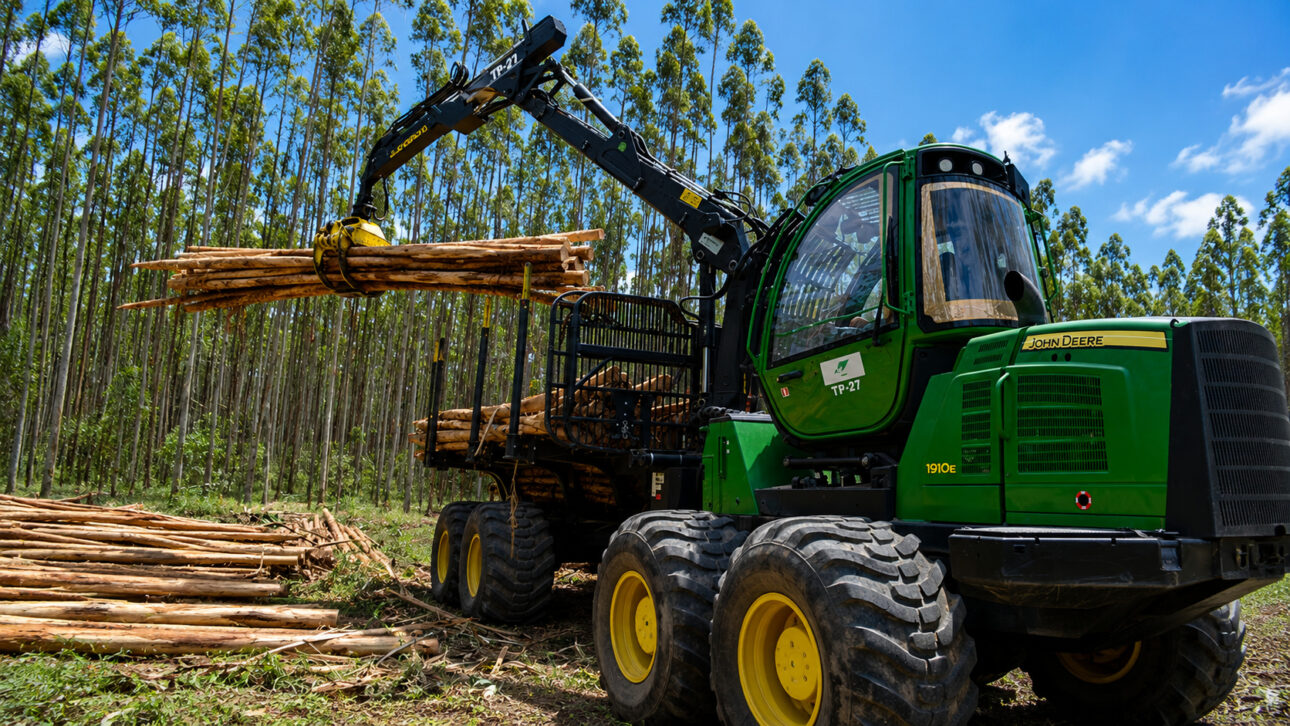
In practice, it functions as an articulated forest truck, with large tires, high traction, a protected cabin, and its own crane to pick up the wood from the ground and organize the load on the rear structure.
The 19-ton capacity explains why the machine is essential in the pulp chain
The strongest number of the 1910E is its load capacity. According to the technical material from John Deere Brazil, the model supports up to 19 tons, a volume sufficient to transport a significant amount of wood in a single trip within the forest.
This capability reduces the number of trips needed between the cutting area and the transfer point. In large-scale operations, this means increased productivity, shorter cycle times, and better utilization of staff and equipment.
The forwarder does not replace the road truck. It performs the tasks that the road truck is not designed to do: enter the plot, travel on uneven ground, and remove the wood to an accessible area.
The engine delivers 186 kW and 249 hp, according to John Deere’s international specifications
In addition to load capacity, power helps explain the equipment’s strength. According to John Deere’s New Zealand page, the 1910E has an engine of 186 kW, equivalent to 249 hp. The same source reports a traction force of 220 kN.
These numbers are important because forestry operations require torque and control at low speeds. The equipment needs to leave loaded, overcome wet ground, maneuver between rows of trees, and operate with stability even in difficult conditions.
Instead of seeking high speed, the design prioritizes traction, robustness, and control. The machine needs to work consistently during long shifts, often in locations far from urban infrastructure.
The crane reaches up to 8.5 meters to pick up logs without repositioning the machine all the time
Another differentiator of the forwarder is the hydraulic crane. According to the technical specifications of John Deere New Zealand, the 1910E can have an arm reach of 7.2 m or 8.5 m, depending on the configuration. This reach allows for collecting logs in a wide area around the machine, reducing the need to reposition the vehicle constantly. In forest terrains, this is crucial for saving time and reducing excessive soil compaction.
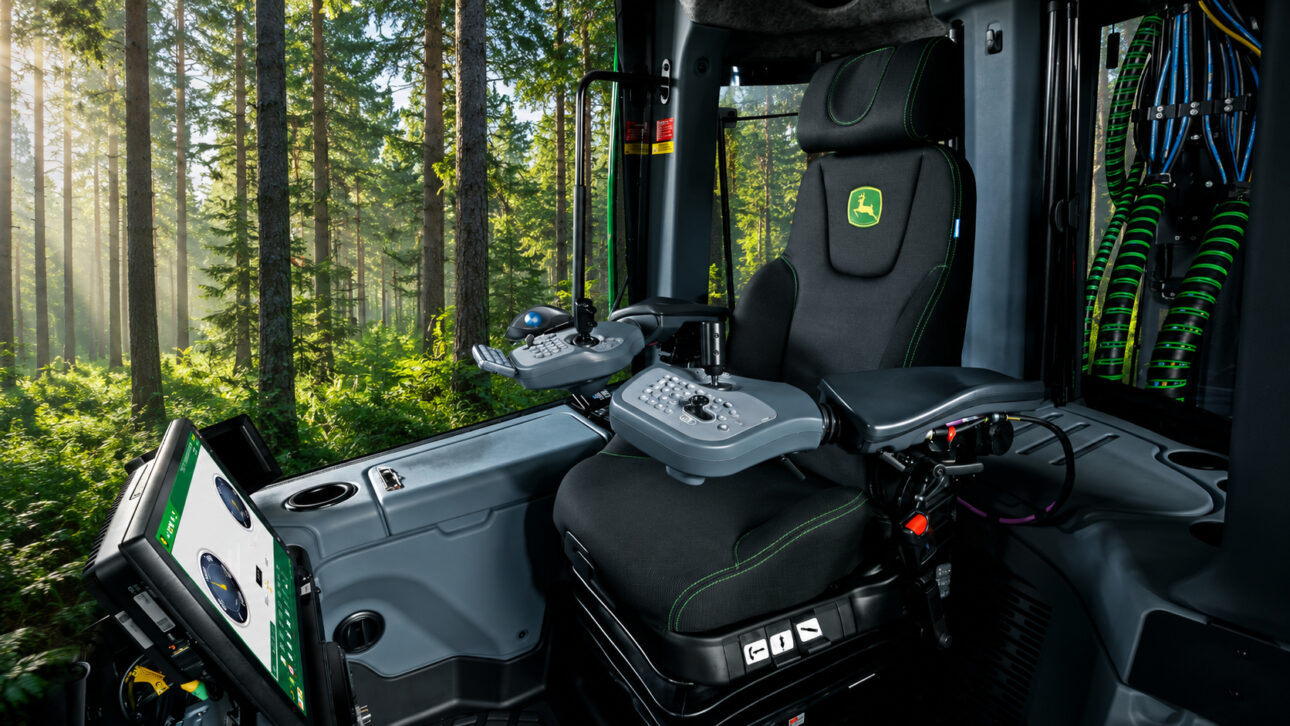
The operator uses the crane to pick up the wood, place it in the cargo box, and organize the weight evenly. The work requires precision because productivity depends on the loading speed and the machine’s stability during transport.
The speed is low, but the work demands precision and endurance
A forwarder of this type is not made for speed. According to the specialized publication Logging On, the John Deere 1910E has a maximum speed in the range of 21 km/h in one of the technical configurations cited for the model. The same source indicates a machine weight of 19,050 kg in the 6-wheel version and 21,800 kg in the 8-wheel version, depending on the configuration.
These data show the nature of the machine. It is heavy, slow, and extremely focused on fieldwork. The goal is not to cover long distances at high speed, but to transport heavy loads with control in areas where the terrain changes all the time. In a planted forest, productivity depends on the efficient repetition of cycles: loading, leaving the plot, unloading, and returning. The forwarder is optimized for this type of routine.
The 1910E stands between the cut tree and the truck heading to the industry
The wood chain operates in stages. First comes planting, then forest growth, mechanized cutting, forwarding, transshipment, road transport, and arrival at the factory. The forwarder operates in forwarding, an intermediate stage that connects cutting to the main transport.
According to John Deere Brazil, the 1910E was developed for heavy operations within the brand’s line of forwarders, with superior capacity to the smaller models in the family. This makes it a strategic piece of equipment for high-demand forestry operations.
Without machines like this, the wood would have to be removed with less efficient methods or with vehicles unsuitable for the terrain. This would increase time, cost, wear, and operational risk.
The machine helps explain how planted forests became a high-scale industrial operation
The modern forestry sector depends on intense mechanization. The traditional image of manual wood cutting no longer represents the large eucalyptus, pine, and pulp operations in many countries.
Machines like the John Deere 1910E show how the planted forest has become an outdoor industrial operation. There is planning of lines, internal routes, mechanized harvesting, transshipment, telemetry, and specific machines for each stage.
According to John Deere, the 1910E combines high load capacity, a 186 kW engine, and a traction force of 220 kN in the model’s international specifications, reinforcing its role as equipment for severe forestry transport operations.
The discreet giant that almost no one sees but sustains part of the wood industry
The John Deere 1910E does not appear on highways, does not attract attention in urban centers, and is rarely seen by those who consume paper, furniture, packaging, or cellulose-derived products. Even so, it is in one of the most important stages of the chain.


According to John Deere Brazil, its capacity of up to 19 tons per trip makes it the largest forwarder of the E Series family, created to remove wood from areas where regular trucks cannot enter safely or productively.
In the end, the 1910E is a backstage machine. It does not transport the wood to the factory, but it makes this transport possible. Between the cut tree and the industry that transforms wood into product, there is a giant articulated, slow, and powerful machine, overcoming mud, slopes, and narrow trails to keep the forest chain running.