Portuguese
  Spanish


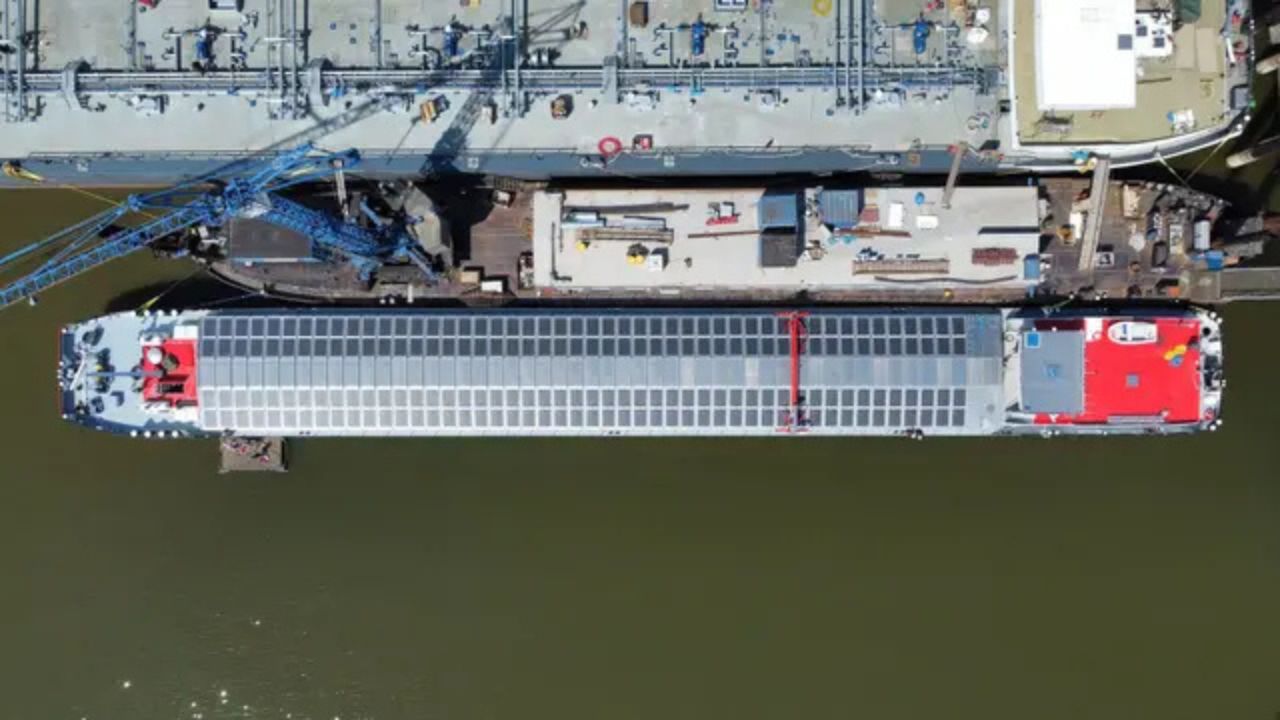

Green Technology Redefines Navigation, Powered by 192 Solar Panels and 37,500 kWh of Clean Energy Annually.
Get ready for a new era in navigation. The world’s first hybrid solar cargo ship, the Blue Marlin, is ready. It promises to transform cargo transport, combining innovation and sustainability.
The Partnership Between Wattlab and HGK Shipping Revolutionizes
The decarbonization of waterway transport gains massive momentum. This is thanks to a visionary partnership between the Dutch Wattlab, a solar energy specialist, and the German HGK Shipping, a giant in inland shipping. The hybrid solar cargo ship Blue Marlin is the result of this union. Its baptism ceremony took place in Hamburg, Germany, on July 3rd. This milestone seals the commitment to a greener future.
How the Blue Marlin Generates 37,500 kWh/Year of Clean Energy
The technology onboard the Blue Marlin is impressive. It features 192 solar panels that generate an astounding 37,500 kilowatt-hours (kWh) of electricity per year. The installation took place at the De Gerlien van Tiem shipyard in the Netherlands. This solar energy powers the onboard systems and, crucially, the ship’s propulsion. The Blue Marlin is the first inland transport vessel to depend directly on solar energy. Furthermore, it has a “Future Fuel Ready” diesel-electric propulsion system and optimization to operate in shallow waters. The SEAFAR technology allows for remotely controlled navigation.
-
The U.S. Navy Conducts Submarine Tests in Idaho Lake to Detect Underwater Noises Hidden by the Ocean

-
Nuclear Submarine USS Alexandria Retired After 35 Years, Having Completed Over 1 Million Miles in Missions

-
MODEC Introduces New Hull Design for FPSO Gato do Mato to Produce Up to 120,000 Barrels of Oil Per Day in Brazil’s Pre-Salt Region
-
This Massive 12-Meter, 21-Ton Underwater Drone Can Operate Autonomously for Up to Five Days


Efficiency and Sustainability in Shallow Waters
With a length of 86 meters and a width of 9.5 meters, the Blue Marlin is designed for maximum efficiency. Its draft of only 1.10 meters is perfect for operations in shallow waters. Maneuverability is ensured by Veth twin propellers and a bow thruster. Its modular design allows for barge coupling, increasing its capacity to up to 3,110 tons of cargo. The hybrid solar cargo ship mainly transports bulk goods for Salzgitter AG, one of Europe’s largest steel producers.
Less CO2, More Efficiency in Inland Transport
The solar installation of the Blue Marlin operates in harmony with four diesel generators. This synergy allows for “peak shaving,” reducing energy consumption during peak hours. The automated energy management system distributes electricity precisely, optimizing efficiency and cutting fuel consumption. The expectation is a significant reduction in CO2 emissions, potentially reaching 36,000 kg per year. The hybrid solar cargo ship Blue Marlin has already been recognized with the prestigious Gold Green Award. It is a giant step towards sustainability in logistics.