






 Portuguese
  Spanish


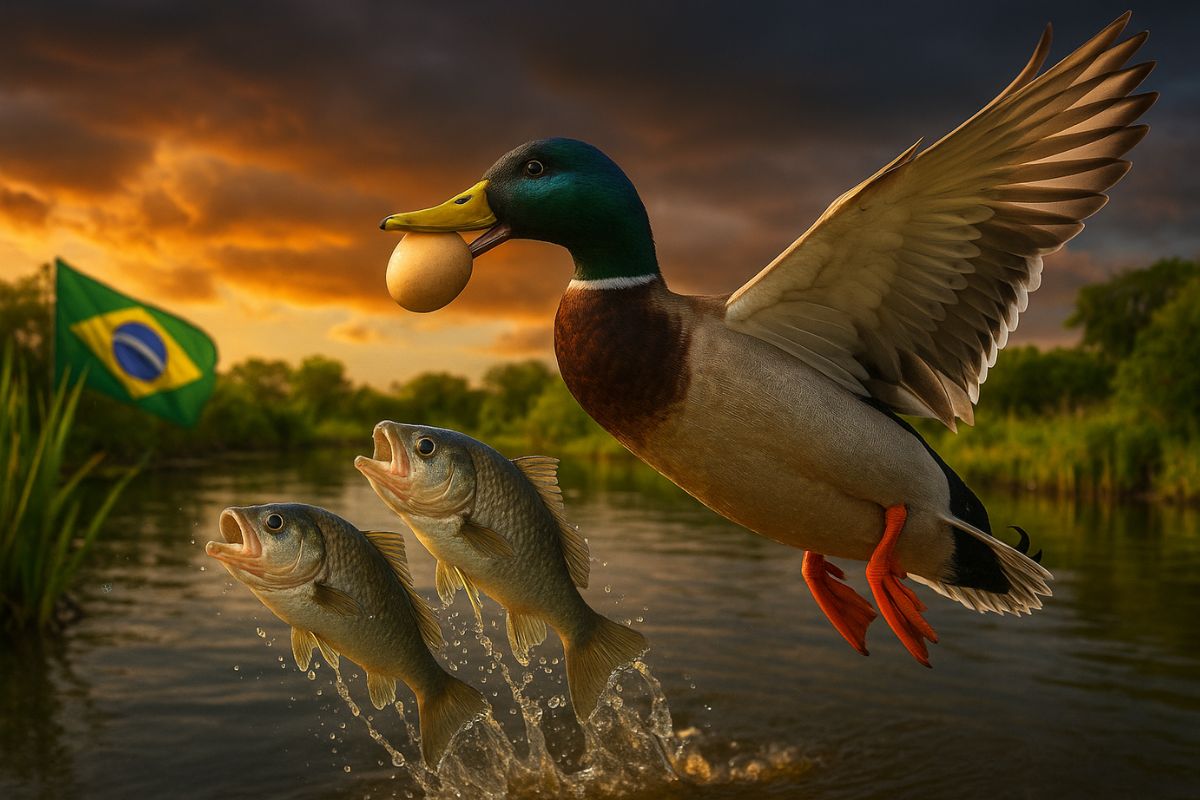


Without Rivers and Without Humans: Fish Appear in Mountain Lakes Because Eggs Travel in Ducks’ Intestines and “Land” Alive in New Isolated Habitats
The presence of fish in isolated mountain lakes has always intrigued scientists and local communities. How do these animals reach environments without connecting rivers, without a link to the sea, and in areas where humans have never made artificial introductions?
The answer may lie in a surprising natural phenomenon: the biological transport of eggs by aquatic birds, especially ducks, which ingest the eggs in one lake and release them in another, miles away.
Recent studies show that some of these eggs survive the digestive process and manage to hatch in new environments, giving rise to entire populations in previously uninhabited locations.
-
Brazilian Construction Worker Moves to France, Earns Up to €2,500 Monthly with Home Renovations, Gains Social Media Attention

-
US Navy Sinks USS Oriskany with 230 kg of C-4, Creating World’s Largest Artificial Reef in 37 Minutes

-
U.S. Dumped Tanks, Jeeps, and Coca-Cola into the Pacific in 1945 After British and French Lowball Offer, Creating “Million Dollar Point”
-
WHO Warns of Unnecessary Interventions in Natural Births Worldwide, Advocates for More Human-Centered Care, Reigniting Debate on Medicalization




This mechanism expands the understanding of species dispersal and reinforces how nature finds unexpected ways to colonize isolated areas.
Traditional Hypotheses Do Not Explain All Cases
Historically, three explanations were used to justify the presence of fish in remote lakes.
The first involves temporary overflow: during periods of heavy rain, ephemeral channels connect neighboring lakes, allowing animals to pass through.
Although valid, this hypothesis does not resolve cases where the lake is at the highest point in the region.
The second is what’s called aerial stocking, a practice in which environmental agencies release fish from airplanes to stock mountain lakes and stimulate sport fishing.
Despite being documented in various countries, it does not apply to all scenarios, especially those where there is no record of human intervention.
The third hypothesis — now supported by evidence — is dispersal by birds.
Ducks and other aquatic species ingest fish eggs in one lake, travel long distances, and release these still-viable eggs in another body of water, where they can hatch and give rise to new populations.
The Role of Ducks as “Natural Carriers”


The mechanism works because some fish eggs have tough enough shells to withstand passage through the birds’ digestive tracts.
Upon landing in another lake, the duck releases feces that contain some of these eggs, still with development potential.
This process has been proven in controlled experiments: eggs ingested by ducks were recovered viable after digestion and, under suitable conditions, hatched normally.
Thus, aquatic birds end up acting as natural dispersal vectors, transporting species to previously inaccessible environments.
Ecological Implications and Parallels in Nature
This phenomenon demonstrates how dispersal of organisms is a powerful force in the evolution and colonization of habitats.
The transport of eggs by birds is not an isolated case: nature has already recorded flamingos displaced by hurricanes for thousands of kilometers, monkeys traveling on floating “islands” of vegetation, and even resilient seeds crossing oceans to colonize new lands.
In the case of fish, biological transport explains why some isolated lakes, once considered sterile, now host stable populations of local species.
This natural process reduces dependence on human intervention and highlights the importance of migratory birds in ecological balance.
The discovery reinforces that nature uses unlikely routes to maintain biodiversity.
Ducks, without intention, become colonization agents by carrying fish eggs in their movements, allowing isolated lakes to harbor aquatic life.
And you, have you heard of this unusual form of dispersal? Do you think nature can be more efficient than any human action in this process? Share your opinion in the comments — we want to hear your thoughts on this phenomenon.




Temos que entender que o planeta Terra não precisa de nós, ele ficaria muito bem se o ser humano desaparecer.
O planeta possui redes de conexão e fluxos invisíveis e desconhecidos ao Ser Humano. É fundamental respeitar o equilíbrio alcançado pela Natureza em milhões de anos de evolução, diminuindo nossos impactos negativos e reconhecendo que há muito a descobrir.
Já ouvi um matuto falando sobre essa forma de dispersão.
Eu mesmo, quando pequeno
perguntei.