Portuguese
  Spanish


Study indicates that leaks, measurement failures, and network inefficiency cause the country to lose enough water to supply entire populations for a year
Brazil loses 39.53% of treated water during the distribution process, before it reaches the taps of homes, businesses, and public services. This data was presented by the Instituto Trata Brasil, in partnership with the consultancy GO Associados, in the study “Water Losses 2026,” prepared based on SINISA 2024.
In practice, the volume of physical losses, mainly leaks in networks and distribution structures, reaches about 4.4 billion cubic meters per year. According to the survey, this amount would be enough to supply approximately 77 million Brazilians for a year.
The number is striking because it exceeds by more than twice the population that still lives without access to potable water in the country, estimated at about 33 million people. The loss also exposes a paradox of Brazilian sanitation: the country captures, treats, and pumps water, but a significant portion of the resource is lost before fulfilling its basic function.
-
WHO Warns of Unnecessary Interventions in Natural Births Worldwide, Advocates for More Human-Centered Care, Reigniting Debate on Medicalization

-
World War II American Bombs Discovered in German City Prompt Evacuation of 20,500 Residents

-
World’s Largest Ice Cave Extends 42 km Beneath Austrian Alps, Revealing a Vast Frozen Realm Preserved by Natural Air Currents

-
Volcanic Soils from Destructive Eruptions Turn into Million-Dollar Crops: Ashes Nourish Grapes in Lanzarote, Bananas in the Canary Islands, Blood Oranges on Mount Etna, and Cacti in Mexico, Showcasing How Lava-Formed Lands Sustain Rare Harvests in Seemingly Barren Regions



The problem is not only in domestic consumption or individual water use. It appears mainly in the infrastructure, in old networks, operational failures, irregular connections, inaccurate water meters, and leaks that often remain invisible for long periods.
Water losses in Brazil involve leaks and commercial failures
In sanitation, water loss can be divided into two major groups. The so-called real losses are those caused by leaks, pipe bursts, overflows in reservoirs, and physical failures in the network. Meanwhile, apparent losses involve water consumed but not correctly recorded, due to measurement errors, fraud, illegal connections, or registration failures.
According to the Instituto Trata Brasil, the national index of 39.53% shows that almost four out of every ten liters of treated water do not reach the final consumer regularly. This volume represents an environmental, operational, and financial cost because the water has already been captured, treated, and transported.
ANA, the National Water and Basic Sanitation Agency, has also started addressing the issue as part of the sector’s regulation. In a reference standard approved in 2025, the agency defined guidelines for management, control, and monitoring plans for losses in potable water distribution systems.
These plans should consider standardized diagnostics, monitoring of real and apparent losses, use of indicators, and adoption of technical solutions. Among the mentioned tools are telemetry, pressure sensors, smart metering, georeferencing, and leak prediction models.
Lost volume could supply millions without seeking new water sources
The impact of losses goes beyond the water bill. When a city wastes a large portion of what it has already treated, it needs to capture more water from rivers, reservoirs, and aquifers to deliver the same useful volume to the population. This increases the pressure on water sources and raises operational costs.
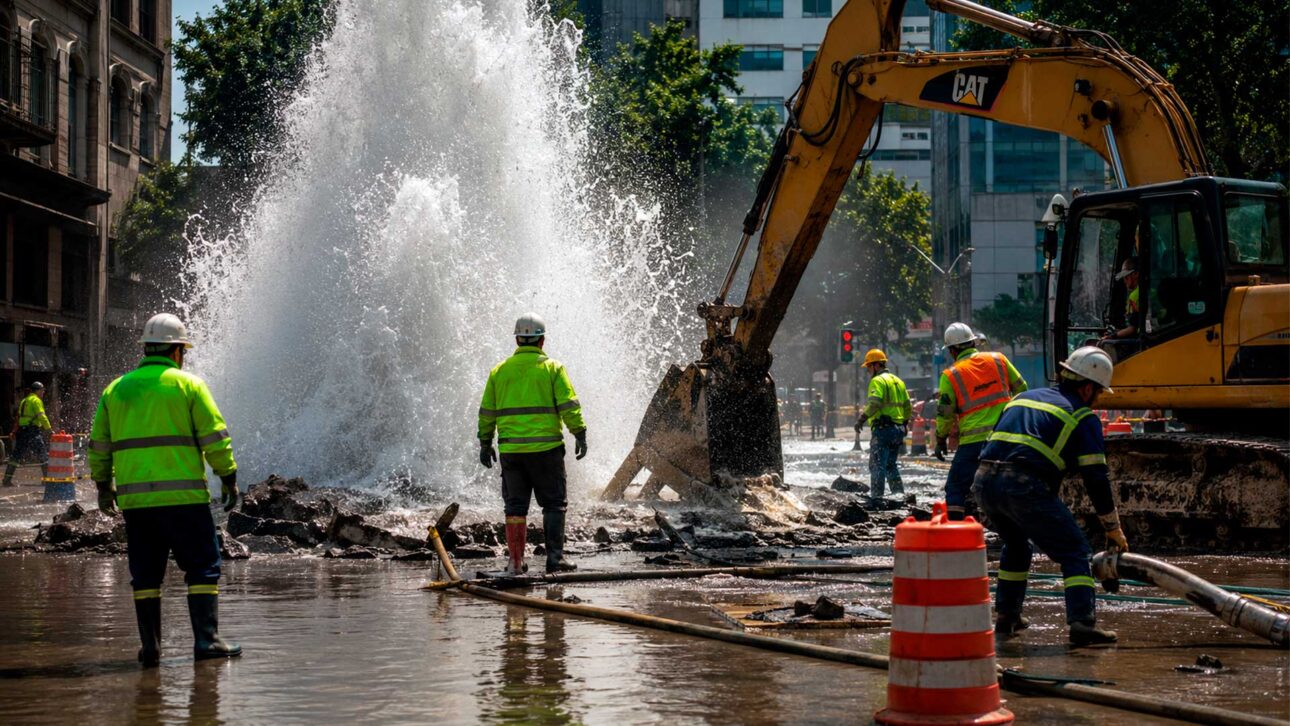
According to the survey echoed by the Instituto Humanitas Unisinos, the volume of physical losses in 2024 is equivalent to about 4,800 Olympic pools wasted per day. The comparison helps to size a problem that, in everyday life, usually remains hidden beneath the streets.
Another way to measure the impact is to look at families without adequate service. The study indicates that the water lost in leaks and physical failures would be enough to supply, for two years, the 17.2 million Brazilians living in vulnerable communities.
This data shows that combating losses is not just a technical agenda for sanitation companies. It is a measure linked to water security, public health, social justice, and climate adaptation, especially during prolonged droughts and extreme events.
Federal target foresees gradual reduction by 2033
Brazil has a formal target to reduce distribution losses. The Portaria MCID nº 788/2024, from the Ministry of Cities, established progressive parameters for municipalities receiving federal public funds or financing with Union resources.
According to the rules, the indicators must be equal to or less than 35% by 2025, fall to 30% between 2026 and 2032, and reach 25% from 2033. There are also targets for losses per connection, which measure the average volume lost per active water connection.
The challenge is significant because the current national index, at 39.53%, is still far from the excellence level expected for 2033. The difference indicates that many municipalities will need to accelerate investments in network sectorization, pipeline replacement, automation, pressure control, and measurement improvement.
According to the Instituto Trata Brasil, reducing total losses from the current 39.53% to 25% would save about 2.8 billion cubic meters of water per year. This volume could supply approximately 48 million people for a year.
North and Northeast concentrate the biggest challenges
Regional inequality is strongly highlighted in the study. The highest loss rates are mainly concentrated in the North and Northeast regions, which also face the worst indicators of access to water, sewage collection, and treatment.
Among the states with losses exceeding 55% are Alagoas, Roraima, Pará, Maranhão, Acre, and Sergipe. This means that, in some places, more than half of the treated water can be lost before it regularly reaches the population.
On the other hand, states like Goiás, Mato Grosso do Sul, Federal District, São Paulo, and Paraná show lower rates, although there is still room for improvement. The survey also highlights that Piauí presented the lowest state average in the distribution loss indicator.
In the 100 most populous municipalities in the country, only a small portion managed to simultaneously achieve the excellence standards defined for distribution losses and losses per connection. Among the capitals, Goiânia, São Paulo, Campo Grande, and Teresina are among those that fell below the 25% target in distribution losses.
Reducing losses can also generate billion-dollar economic gains
Lost water represents money leaving the system without providing service. There are costs with energy for pumping, chemicals for treatment, network maintenance, station operation, and the use of structures that work above what is necessary.
The study estimates that reducing losses to the realistically considered scenario of 25% by 2033 could generate gross gains of R$ 47.3 billion over the period. Considering the necessary investments to achieve this reduction, the estimated net benefit would be R$ 23.6 billion over ten years.
The savings do not only mean surplus cash for sanitation companies. Less waste can reduce pressure on future tariffs, free up resources for service expansion, and improve the financial sustainability of services.
For sector specialists, reducing losses is one of the most efficient ways to increase water availability without immediately seeking new sources of capture. Instead of always expanding production, the path involves better utilizing the water that is already treated.
Efficient sanitation depends on management, technology, and oversight
Combating losses requires a combination of management, investment, and oversight. Replacing old pipelines is important, but it doesn’t solve everything on its own. Municipalities and providers need to map the network, accurately measure the water produced, monitor pressures, and identify critical leakage points.
Proper metering is also essential. When consumption is not measured correctly, the system loses information, revenue, and planning capacity. This makes it difficult to know where the water is being used, where it is being lost, and which areas need urgent intervention.
Another important point is transparency. ANA’s regulation provides for the publication of results and monitoring by regulatory entities, which can help society compare performance and demand clearer goals.
With climate change putting pressure on water sources and increasing the frequency of extremes, losing treated water is no longer just an operational failure. It is a strategic problem for cities that need to ensure supply, reduce inequalities, and protect their water resources.