Portuguese
  Spanish


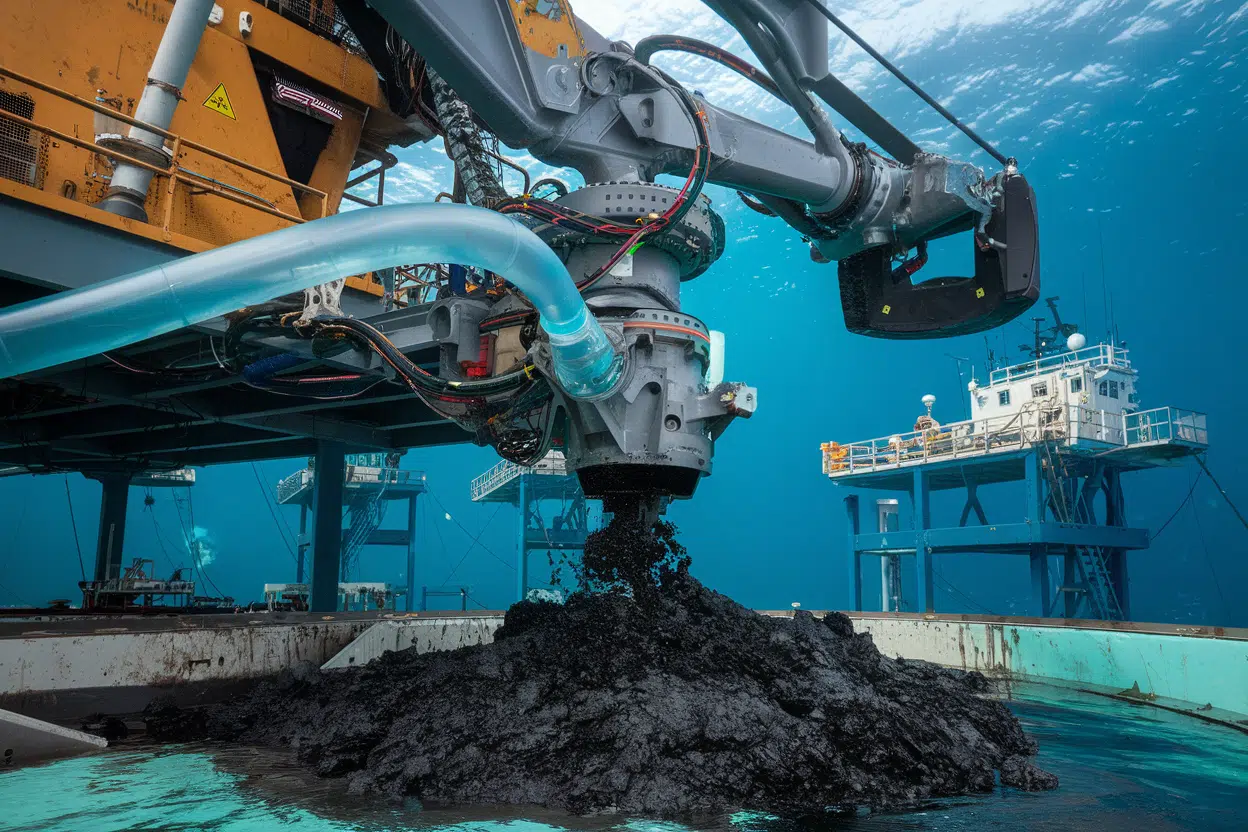


Discover The Next Great Battle Between The US And China For Submarine Uranium Mining. The Race To Extract 4.5 Billion Tons From The Seafloor Is Just Beginning!
Although the two powers consume more than 30% of uranium globally, the United States and China are responsible for less than 5% of production, according to data from the ‘World Nuclear Association’. This significant gap between what they need and what they have has resulted in an escalating battle due to a major temptation: at the bottom of the oceans lies a vast reserve of uranium to be extracted through submarine mining.
4.5 Billion Tons of Uranium in The Sea
It was in 2012 when the Nuclear Energy Agency and the International Atomic Energy Agency quantified the enormous amount of uranium that existed on the seafloor: 4.5 billion tons of uranium, floating on the ocean floor, dissolved as uranyl ions. This is an enormous quantity, a reserve more than a thousand times greater than that found on land, mainly belonging to countries like Kazakhstan, Canada, and Australia, which have the largest mines.
Submarine Mining: An Extremely Complex Challenge
The problem is that extracting uranium from these ions is extremely complex. One trick is to use plastic substrates with chemicals akin to uranium, so that uranium separates out. “You obtain between 2 and 4 grams of uranium per kilogram of plastic”, explained Erich Schneider, a nuclear engineer from the University of Texas. But this method was very expensive, about $1,230 per kilogram of uranium, roughly ten times more expensive than traditional mining. It is worth noting that these calculations are from over a decade ago.
-
Giant 142 kg Emerald from Brazil’s Bahia Region Auctioned with Starting Bid of Nearly $16 Million

-
Study Reveals 97% of Pregnant Munduruku Women in the Brazilian Amazon Have Mercury Levels Above Safe Limits, 90% of Newborns Contaminated by Gold Mining
-
China could reduce iron ore imports from 80% to 50% of consumption by 2030, while its share in global steel production falls from 52% to 46%, in a shift that could reshape the global market, says CMRG.
-
Brazil is sitting on one of the largest lithium reserves in the world, in the Jequitinhonha Valley, but national mining has almost become an appendage of China: 97% of the metal’s export goes to a single country, which also dominates refining.


The Battle Begins In The Laboratories
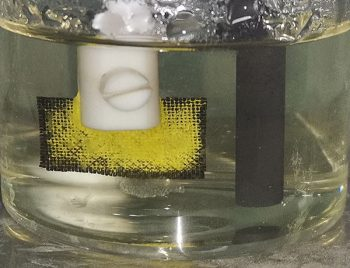
At the end of 2023, at the American Chemical Society (ACS), a study was published funded by China’s National Program that presented a more effective method for capturing uranium ions from seawater. The team began with a flexible fabric woven with carbon fibers and added a graphite anode to then pass a cyclic current between the electrodes. With this method, the researchers managed to extract 12.6 milligrams of uranium per gram of coated active material over 24 days, a method much more efficient than those used until then.
This research marked a turning point, as it doubled what was achieved by the U.S. Department of Energy, whose best results with polyethylene fibers obtained about six grams per kilo. There is much at stake, but the truth is that extracting uranium from the seafloor is still far from being a real possibility. Research is advancing, but in practice, it would require enormous facilities. The dream of multiplying the planet’s uranium supply by ten is tempting enough to keep trying.
Environmental Impact of Submarine Uranium Mining
A crucial aspect that must be considered in the race for submarine uranium extraction is the environmental impact. Submarine mining is not without controversy. Several studies indicate that disturbing the seabed can have devastating effects on underwater ecosystems. Marine conservation experts warn that extraction efforts could damage still-unknown marine species, alter migratory patterns, and affect ocean biodiversity.
International organizations, such as the International Seabed Authority (ISA), have already begun to regulate submarine mining. However, some critics argue that current regulations are insufficient to protect the marine environment, especially in light of the possibility of large-scale resource extraction. The preservation of the oceans will be a central theme in discussions on how to proceed with submarine mining, and world powers will need to balance the demand for resources with environmental protection.
Parallel Technological Advances
Besides uranium, other submarine mining industries are expanding, such as the extraction of rare minerals essential for manufacturing electronics and electric vehicle batteries. Private companies and governments are already investing in new robotics and automation technologies, which will be crucial to making submarine mining viable on a commercial scale. Although these technologies are in their early stages, their success could be critical to the future of deep-sea mining.
Geopolitics and The Race for Marine Resources
Access to these vast submarine resources may reshape the geopolitical relations between major world powers. Countries that currently rely on uranium imports, such as the United States, see submarine mining as an opportunity to reduce their dependence on foreign suppliers, thereby improving their energy security. On the other hand, China, which has heavily invested in the development of submarine mining technologies, also seeks to establish itself as a leader in the extraction of natural resources from the oceans.


Future Prospects
As technology continues to develop, submarine uranium mining may become a viable reality in the future. This will require significant advancements in extraction techniques and cost reduction. The growing demand for nuclear energy, driven by the need for clean energy sources, may accelerate these developments. Uranium mining on the seafloor represents an uncharted frontier that could redefine the geopolitics of nuclear energy, placing the United States and China once again in a race to dominate this new source of strategic resource.